Estate Planning for Newlyweds in NC: 5 First Steps
October 11, 2026 · Ryan P. Duffy


Marriage gives your spouse important legal rights in North Carolina, but it does not coordinate your entire estate plan. Estate planning for newlyweds means reviewing old documents, account records and decision-makers together—not assuming a marriage certificate updates everything.
You do not need to solve every future family question in one evening. Start with what would happen if one of you could not make decisions, then what should happen after a death. If you have children, especially children from a previous relationship, add a deliberate plan for caregiving and inheritance rather than relying on defaults.
What marriage changes—and what it does not
A qualifying surviving spouse has inheritance rights under North Carolina law. If someone dies without a will, the spouse may share property with children or parents depending on the family and asset circumstances. It is not accurate to say that the parents ordinarily inherit everything despite an intact marriage. G.S. 29-14 sets out the spouse’s intestate share and distinguishes real and personal property.
At the same time, G.S. 31-5.3 states that marriage does not revoke a will. A previously signed document may still contain gifts and executor choices that no longer fit. Existing healthcare agents and financial agents also deserve review.
Account ownership, beneficiary forms, federal spousal protections, and valid agreements can change the result for particular assets. Do not assume that either the old beneficiary form or the new marriage automatically resolves every account. Obtain the provider’s current record and check the applicable rules.
Read this diagram as text
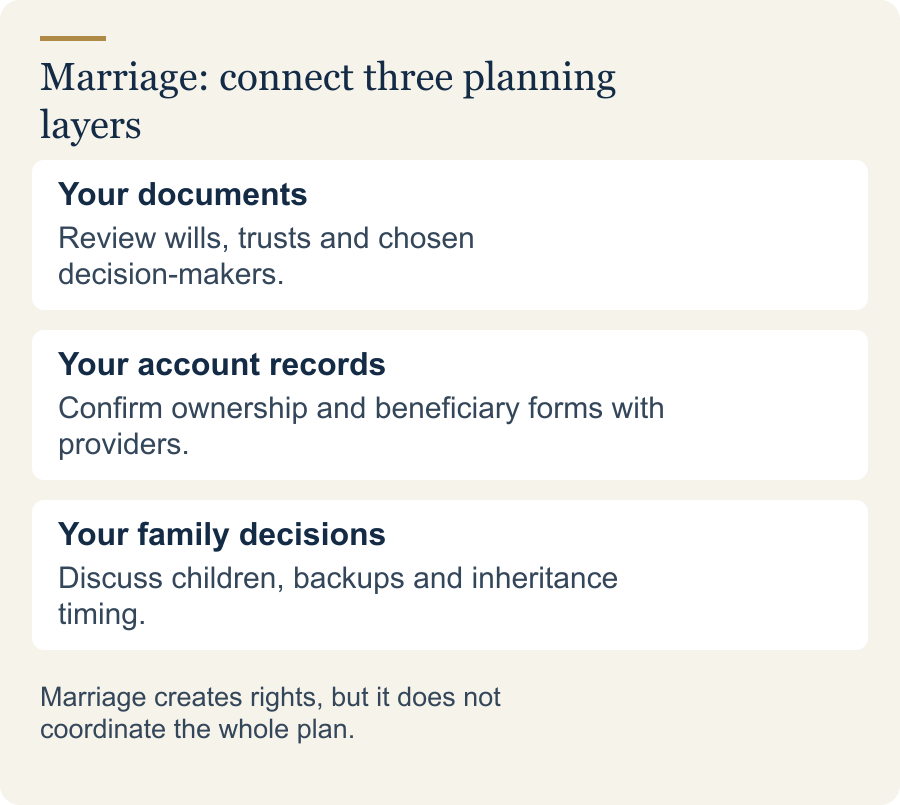
Your documents: Review wills, trusts and chosen decision-makers. Your account records: Confirm ownership and beneficiary forms with providers. Your family decisions: Discuss children, backups and inheritance timing.
Step 1: review beneficiaries by account type
Make a list of each account and policy, its owner, its primary beneficiary and its backup beneficiary. Then review the list against your intended plan. A will generally does not override a valid contractual beneficiary designation simply because it was signed later.
- Employer retirement plans: check plan terms, survivor benefits and any spousal-consent requirements. The IRS retirement-plan death-benefit guidance explains why spousal rights matter.
- IRAs: review spouse-versus-nonspouse tax treatment, contingent beneficiaries and inherited-account distribution rules. A trust beneficiary needs separate analysis under IRS Publication 590-B.
- Life insurance: coordinate the intended recipient with support needs and any trust for children. Naming a minor outright can create management problems.
- Health savings accounts: a spouse beneficiary can continue the account as an HSA; a nonspouse designation generally ends HSA treatment and creates different tax consequences. See IRS Publication 969.
Having a trust is not a reason to name it on every form. Clients should complete provider changes only after the account-specific plan is clear, then retain the provider’s confirmation. A saved intention in your notes is not the same as an accepted beneficiary change.
Read this diagram as text
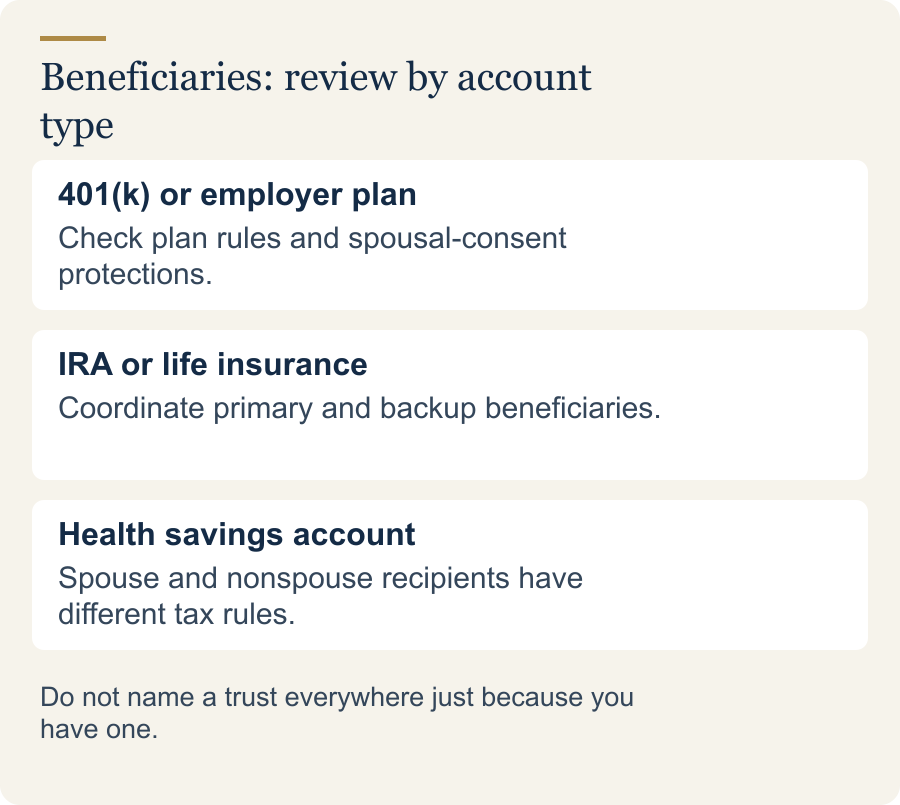
401(k) or employer plan: Check plan rules and spousal-consent protections. IRA or life insurance: Coordinate primary and backup beneficiaries. Health savings account: Spouse and nonspouse recipients have different tax rules.
Step 2: coordinate wills and surviving-spouse rights
A will can name an executor, direct probate property, and recommend guardians for minor children. It does not control every jointly owned or beneficiary-designated asset. Review the document alongside title and beneficiary records so that the pieces work together.
North Carolina also has an elective-share statute, which is different from intestacy. Under G.S. 30-3.1, the applicable percentage is:
- Marriage of less than five years: 15%.
- Five years but less than ten: 25%.
- Ten years but less than fifteen: 33%.
- Fifteen years or more: 50%.
These percentages apply through the statute’s defined Total Net Assets calculation, with credit for defined net property passing to the spouse. They are not an extra percentage of the probate estate automatically paid on top of everything else. Filing requirements, deadlines, disqualification and valid waivers can affect the right. Bring any premarital or marital agreement to your planning meeting.
For a blended family, the practical question is often how to support a surviving spouse while preserving an eventual inheritance for children. Leaving everything outright to a spouse and hoping for a later gift may not accomplish that goal. Discuss the actual tradeoffs before selecting trust terms.
Step 3: choose financial and healthcare decision-makers
Your spouse may not be able to manage every individually owned account or sign every transaction merely because you are married. A financial power of attorney can authorize a chosen agent to act within its terms. Decide who should serve, which backup is appropriate, and where the signed document will be available.
Medical decisions work differently. North Carolina’s medical-consent hierarchy includes a spouse after specified guardians and appointed agents. A spouse is not automatically powerless without a healthcare power of attorney. But a new marriage does not necessarily displace an existing valid agent.
A healthcare power of attorney lets you choose the person and backup you trust and define authority. Advance directives can also communicate treatment preferences. Have the discussion about values while neither of you is under the pressure of an emergency, and tell the selected people where to find the documents.
Step 4: connect your plan to children and your home
Suppose one newlywed has a four-year-old from a prior relationship and the couple hopes to have another child. The questions include the other parent’s rights, a possible guardian nomination, support for the spouse, and who would manage the children’s money. A single instruction to “leave everything to my spouse” does not answer all of them.
For minor children, distinguish the caregiver from the trustee managing trust-owned assets. They may be different people. A parent recommends a guardian in a will, but the court makes an appointment when needed; a nomination does not override a surviving parent’s rights. A children’s trust can provide support before selected distribution ages rather than requiring a lump sum at 18.

If you own a home, review the recorded deed and the existing mortgage rather than assuming both spouses are already on title. Adding a spouse or transferring property to a trust can have legal, tax, title-insurance and lending implications. Have the proposed deed work evaluated as part of the overall plan.
Step 5: decide whether a trust earns its place
A revocable living trust can help with incapacity management, probate planning for funded assets, and continuing management for children. A will-based plan may also be appropriate. The right choice follows the assets, family structure and desired control—not the assumption that every newlywed needs the same package.
Our trust-based plans generally range from $3,500 to $5,500, with the engagement defining the actual scope and fee. The process usually involves two Microsoft Teams meetings, homework, and about four to six weeks. Signing is in person with mobile-notary assistance; virtual meetings do not mean every document is signed in person.
Agreed first-deed/primary-residence work and detailed asset-by-asset funding instructions are included. Clients handle institution forms, other transfers and beneficiary updates. This is not an institution-letter service, completed-funding verification, or ongoing funding review.
What to gather before your planning meeting
- Existing wills, trusts, powers of attorney and advance directives.
- Account and insurance statements showing ownership and beneficiary records.
- Property deeds and relevant mortgage information.
- Names of possible executors, agents, guardians and trustees, including backups.
- Children’s information and any prior-marriage or support agreements.
- Your priorities: spouse support, child inheritance timing, convenience or business continuity.
Keep the list practical. If you disagree about a guardian or trustee, bring the unresolved question rather than guessing just to finish a questionnaire. A planning conversation can help separate caregiving concerns from money-management concerns.
Frequently asked questions
Does marriage cancel my old North Carolina will?
No. Review and update it deliberately; do not rely on marriage to revoke it.
Should my spouse always be my agent?
Not necessarily. Choose someone willing and able to do the job, consider conflicts and practical availability, and name a suitable backup.
Should we name our trust on every account?
No. Retirement accounts, HSAs and life insurance have different rules. Coordinate designations individually with legal and tax advice where needed.
Can we plan before having children?
Yes. Address current decisions now and discuss how later children should be treated. Revisit the plan after a birth, adoption, move or other material change.
Put your shared plan in writing
Complete our consultation qualification form to discuss an NC or SC plan that fits your household. This guide is general legal education, not advice about a particular marriage, account or agreement.


Related estate planning guides
Use these next if you are comparing wills, trusts, probate avoidance, and the cost of a complete plan.
Have questions about your estate plan?
Ryan P. Duffy is a North Carolina and South Carolina licensed estate planning attorney. Schedule a free, no-pressure consultation to discuss your family's specific situation.
Schedule Your Free Consultation