Choosing a Guardian in NC: A Guide for Parents
October 25, 2026 · Ryan P. Duffy


Choosing a guardian for your minor children in North Carolina means recommending a caregiver—not privately appointing one outside the court process. Your will can document a thoughtful nomination and backups. If an appointment becomes necessary, the clerk of superior court makes the decision under North Carolina law and your child’s best interests.
For parents with children aged four and two, the difficult part is often not the document. It is deciding who could provide a stable home and who should manage the money supporting that home. Those are separate jobs, and the best caregiver is not always the best trustee.
What a North Carolina guardian nomination does
Under G.S. 35A-1225, a parent’s recommendation is a strong guide in the absence of a surviving parent, but the clerk is not bound by it if another appointment serves the minor’s best interests. A properly prepared nomination helps communicate your reasoning; it does not guarantee the outcome or eliminate the appointment process.
A nomination also generally does not displace a surviving parent’s rights. G.S. 35A-1224 addresses those rights and who may serve. If there are concerns about another parent, an existing custody order, or a disputed family situation, obtain advice specific to those facts. A sentence in a will is not a substitute for resolving a custody issue.
This is still valuable planning. A clear recommendation, a willing backup, and accessible documents give the people helping your children far better information than an informal conversation that nobody can locate or reliably recall.
Separate the caregiver, property guardian and trustee
North Carolina recognizes different guardianship roles. A guardian of the person addresses personal care. A guardian of the estate manages property owned by the minor under court supervision. A general guardian combines those roles. A trustee managing assets owned by a trust is a different office.
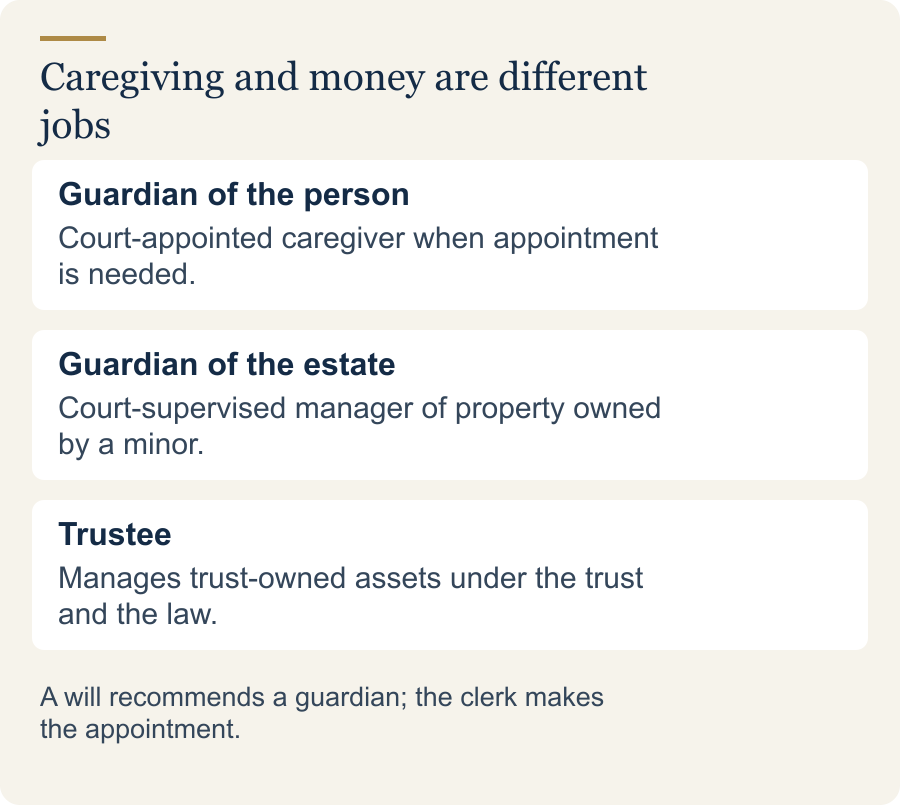
Read this diagram as text
Guardian of the person: Court-appointed caregiver when appointment is needed. Guardian of the estate: Court-supervised manager of property owned by a minor. Trustee: Manages trust-owned assets under the trust and the law.
The distinction is practical. If life insurance is payable directly to a young child, someone may need legal authority to manage the child’s property. If a properly designed trust is the recipient, the trustee manages trust-owned funds under the trust and applicable law. Account designations and trust provisions must actually create that arrangement.
A court-appointed guardian managing a minor’s estate generally has statutory accounting obligations, including annual accounts under G.S. 35A-1264. Parents cannot simply switch those duties off in their wills. Trustees have their own duties; using a trust is not a promise that no reporting, dispute or court proceeding will ever occur.
Choose for everyday parenting, not family rank
Being the closest relative or the wealthiest candidate does not automatically make someone the best caregiver. Think about what raising your children would actually require over the next ten or fifteen years. A loving grandparent may be an excellent immediate support person but need a different long-term arrangement.
- Relationship: do the children know and trust this person?
- Parenting approach: how do they handle routines, discipline, education and emotional needs?
- Capacity: consider health, energy, work schedules, housing and other dependents.
- Family connections: will they help maintain important relationships and keep siblings together where appropriate?
- Willingness: have they genuinely agreed after discussing the responsibilities?
- Practical location: what would change about school, childcare, medical care and community?
Use a short comparison of two or three realistic candidates. Record the most important strengths and concerns rather than trying to calculate a supposedly perfect score. If no option is ideal, choose the best workable plan and review it as circumstances change.
Ask the difficult backup questions now
Speak to the proposed guardian before putting the name in documents. Ask how the household would accommodate the children, whether the person’s partner supports the idea, and what support would make the arrangement workable. “We love them” is a starting point, not the entire conversation.
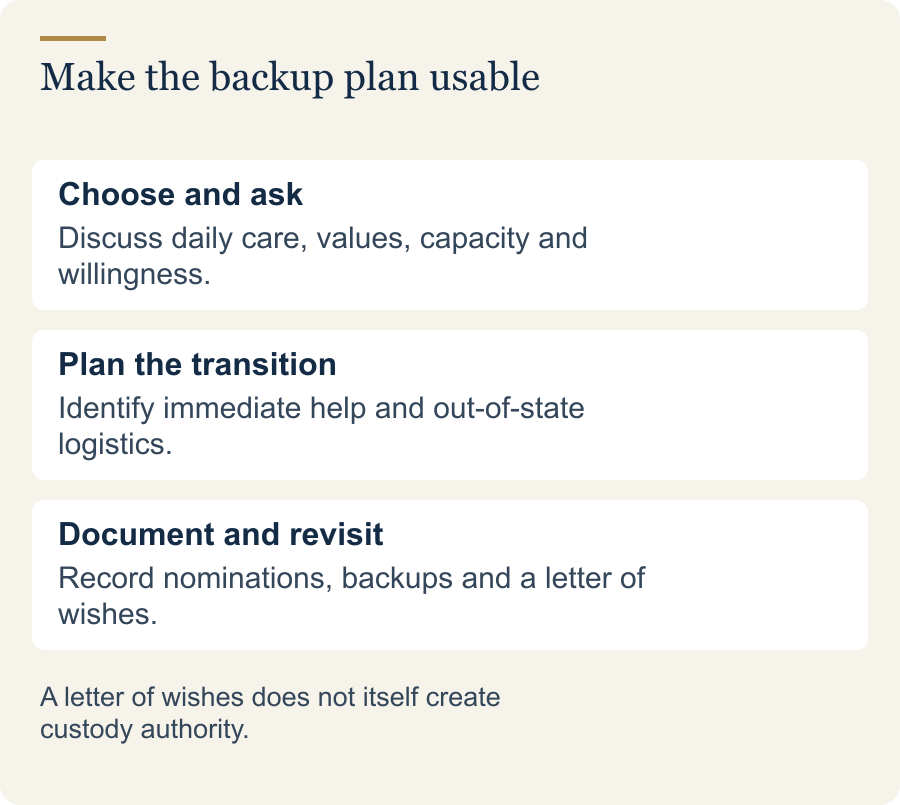
Read this diagram as text
Choose and ask: Discuss daily care, values, capacity and willingness. Plan the transition: Identify immediate help and out-of-state logistics. Document and revisit: Record nominations, backups and a letter of wishes.
If you are considering a couple, discuss what you intend if they separate, one dies, or one cannot serve. Do not assume everyone shares the same answer. An attorney can help express the nomination and alternatives clearly without promising that a document can control every future family event.
Choose at least one suitable backup if possible. Revisit the choices after a move, serious illness, divorce, new child, or a significant change in the candidate’s household. Updating an emergency-contact list alone does not amend a will.
An out-of-state guardian requires a transition plan
North Carolina law permits a qualified adult who is not a North Carolina resident to serve, but distance creates practical questions. If your chosen caregiver lives in another state, who can help your children tonight, who can travel, and where are the legal documents? Court jurisdiction and any interstate issues still need proper handling.
Create a practical emergency information sheet with contacts, school and childcare information, medical needs, allergies and document locations. Discuss any appropriate legal authorizations for temporary care with counsel. A contact sheet or letter does not itself give someone custody or permission to override a parent’s rights.
Keep sensitive information secure but accessible to the people who need it. A beautifully organized plan does little good if nobody knows that it exists or can locate the signed originals when required.
Give the caregiver support without handing a child a lump sum
A family trust can provide a structure for paying appropriate expenses and continuing management after a child reaches 18. You can discuss selected distribution ages, discretionary support, education, housing, and provisions for illness or special circumstances. The trustee should have clear instructions and enough flexibility to respond to actual needs.
For example, imagine a hypothetical family selecting an aunt to raise two children and an uncle to manage their trust. The trustee might pay for childcare, healthcare and education under the trust’s terms while preserving funds for later needs. That division works only if the two people can communicate and the terms explain how support decisions should be made.

Life insurance may be one funding source, but coverage, accepted beneficiary designations, policy terms and available proceeds determine what is actually available. A plan should not assume that naming a trust on paper guarantees a particular payout or removes every financial strain. Review ownership and designations carefully, especially when children are currently named directly.
Our plans include agreed first-deed/primary-residence work and detailed funding instructions. Clients handle institution forms, other transfers and beneficiary updates. We do not complete or verify those institutional funding steps for clients.
Use a letter of wishes for the human details
A nonbinding letter can explain routines, traditions, meaningful relationships, educational hopes and the reasons behind your choices. It can help the caregiver and trustee understand the children as people, not simply as names in legal documents.
Keep the legal and personal functions separate. Binding trust provisions belong in properly prepared documents; a letter of wishes does not amend the trust or confer custody. Avoid rigid instructions that could become harmful as a child grows. A preference for maintaining a school connection, for example, may need flexibility if the caregiver lives far away or the child’s needs change.
For the documents themselves, will planning should coordinate nominations with the overall trust and beneficiary plan. A caregiver decision without a money-management decision leaves a substantial part of the problem unresolved.
Frequently asked questions
Does the person named in my will automatically become guardian?
No. The will recommends a person. The clerk makes an appointment when necessary under the law and the child’s best interests.
Can the guardian and trustee be different people?
Yes. Separating daily caregiving from trust administration can be useful, provided the people can cooperate and the documents define their responsibilities.
Will a nomination override the other parent’s rights?
Generally not. Existing parental rights and custody circumstances require their own analysis; a will is not a way to bypass them.
Must my child receive all trust money at 18?
No. Proper trust terms can continue management beyond 18 and permit support before later distributions. The caregiver’s guardianship timeline and the trust’s duration are separate.
Turn a difficult choice into a workable plan
Bring your candidates, concerns and unresolved questions. Complete our consultation qualification form to discuss an NC or SC family estate plan. This guide explains North Carolina law generally; individual custody and guardianship circumstances need specific advice.


Related estate planning guides
Use these next if you are comparing wills, trusts, probate avoidance, and the cost of a complete plan.
Have questions about your estate plan?
Ryan P. Duffy is a North Carolina and South Carolina licensed estate planning attorney. Schedule a free, no-pressure consultation to discuss your family's specific situation.
Schedule Your Free Consultation