


Estate planning for blended families in North Carolina starts with two separate questions: Who needs support if you die first, and who should inherit what remains later? Leaving everything to a spouse can answer the first question without answering the second. A will also does not automatically control your life insurance, retirement accounts, or jointly owned home.
A useful plan makes room for your actual family: a spouse or partner, children from earlier relationships, children you share, adopted children, and stepchildren you want to include. The goal is not to rank those relationships. It is to make your choices clear, account for legal rights, and give the people carrying out your plan workable instructions.
Who inherits without a plan in North Carolina?
North Carolina’s intestacy rules distribute property that passes through an estate without an effective will. They do not distribute every asset a person owned or define what is emotionally fair for a blended family.
The surviving spouse’s share depends on the relatives who survive and whether the property is real estate or personal property. Children can share the remaining intestate estate, including children from an earlier relationship—not just children of the current marriage. The rules are in N.C. Gen. Stat. §§ 29-14 and 29-15.
An unadopted stepchild does not inherit from a stepparent under those default rules merely because of the stepchild relationship. That is different from saying you cannot leave property to a stepchild. You can deliberately include a stepchild in a will, trust, or appropriate beneficiary designation.
Legally adopted children generally inherit from their adoptive parents as other children do. Adoption can also change inheritance rights through biological relatives, with a specific exception involving a biological parent who has married an adoptive parent. Section 29-17 addresses those rules. Adoption history, legal parentage, and a deceased child’s descendants can require closer analysis.
| Person or asset | Default rule or controlling document | Planning question |
|---|---|---|
| Surviving spouse | May receive an intestate share; other statutory rights can apply even with documents | What support is needed, and how do statutory rights affect the plan? |
| Biological or legally adopted child | Can inherit as a child under applicable intestacy and parentage rules | Should the child receive assets outright, at stages, or through continuing management? |
| Unadopted stepchild | No intestate share solely because of the stepchild relationship | Do the documents expressly include this child and explain what happens if circumstances change? |
| Estate property without an effective will | Intestacy rules, after applicable administration and claims | Who receives it, and could several people become co-owners? |
| Asset with a valid beneficiary or survivorship arrangement | Generally follows that arrangement, subject to applicable law | Does its destination match the will, trust, and family obligations? |
For the statutory shares and examples, see our North Carolina intestate-succession guide. Do not assume a spouse automatically receives everything, or apply the probate percentages to an account that has a different transfer arrangement.
Decide what fairness means for your family
Equal dollar amounts are one possible choice, not the definition of fairness. A young child’s support needs differ from those of an independent adult. One spouse may have a pension while the other reduced paid work to care for children. A stepchild you have raised for years may be someone you want to treat exactly like your other children.
Start by answering these questions together:
- Who needs a home, income, education support, or medical support after either spouse dies?
- Should all children be included, and on the same terms?
- Are there particular assets you want to preserve for particular people?
- Should a child’s share go to that child’s descendants if the child dies first?
- What should happen if a beneficiary has a disability, receives means-tested benefits, or cannot manage money safely?
Tell your attorney about future births, potential adoptions, and whether you want a stepchild’s gift to continue after a divorce. Do not rely on an undefined phrase such as “our children” to resolve every relationship. Names, definitions, and backup provisions need to work together so the plan does not accidentally omit a future child or include someone you did not intend.
Three ways to provide for a spouse and children
There is no single best arrangement for every blended family. Three common approaches illustrate the tradeoffs.
| Approach | What it can accomplish | What requires attention |
|---|---|---|
| Leave assets outright to the spouse | Gives the survivor flexibility and direct control | An outright gift generally does not bind the survivor to preserve a later inheritance for your children |
| Use a trust with spouse-support and remainder provisions | Establishes rules for the spouse’s use of designated assets and names later beneficiaries | Support standards, amendment powers, trustee discretion, expenses, and legal spouse rights must be coordinated |
| Allocate different assets to different goals | Can provide the spouse with one resource and children with another, such as appropriately structured insurance proceeds | Ownership, beneficiary forms, liquidity, policy duration, taxes, and minor-beneficiary management must align |
These approaches can be combined. For example, a spouse might receive some assets outright while a separate trust governs assets intended to support the spouse and later pass to children. A different family may prefer a direct gift to independent adult children and a larger unrestricted gift to the spouse.
What the trust actually needs to say
The label “living trust” does not answer who can change the plan after the first death. The terms need to address what remains amendable, which assets are affected, who receives support, and who receives any remainder. North Carolina’s revocable-trust statute also distinguishes property contributed by multiple settlors.
Ask whether the spouse can receive income, principal, or both; whether other resources must be considered; and who decides. If the trust permits principal to be spent for the spouse, the children’s eventual inheritance may be smaller—or exhausted. That may be an intentional priority, but it should not be disguised as a guaranteed inheritance.
A revocable trust is not a blanket shield from your own creditors; section 36C-5-505(a)(1) addresses claims during the settlor’s life. Nor does a trust eliminate taxes, administration, family disagreement, or the need to put the right assets under its terms. Our revocable living trust page explains the broader role of a trust in a coordinated plan.
A hypothetical family: housing now, inheritance later
Consider Jordan, 41, and Morgan, 39. Jordan has a 12-year-old from an earlier relationship. Morgan has an 8-year-old from an earlier relationship, and they share a 3-year-old. They want all three children included, while making sure the surviving spouse can maintain a stable home.
For illustration only, assume their planning inventory includes a home, $200,000 in non-retirement savings, separate retirement accounts, and a $750,000 term life insurance policy on each spouse. Those figures do not determine the appropriate plan. The deed, debts, policy beneficiaries, prior agreements, and each spouse’s ownership must be reviewed first.
If Jordan leaves everything outright to Morgan, Morgan receives flexibility, but Jordan has not necessarily created an enforceable right for any child to receive what remains. Conversely, leaving a large share immediately to children could leave Morgan without enough accessible money to maintain the home.
They could explore a trust arrangement permitting housing and other defined support for Morgan, with designated remainder shares for the three children. They might also allocate insurance proceeds to a separate children’s trust, or use other assets for a spouse’s support. Each choice must be tested against spouse rights and any existing support or insurance obligations.
The housing provision needs practical answers:
- Who pays the mortgage, taxes, insurance, repairs, and major improvements?
- Can Morgan sell the home and move closer to family or work?
- If a smaller home is purchased, what happens to the remaining proceeds?
- Does the right to occupy end at death, permanent departure, or another clearly defined event?
- Who resolves requests when a child’s needs and the spouse’s needs compete?
The point is not that this family must choose a particular trust. It is that “my spouse can stay in the house” and “the kids get it later” are incomplete instructions. A usable plan addresses both the money and the decisions people will actually face.

A spouse’s legal rights still matter
You cannot safely design a blended-family plan by reading only the beneficiary paragraph in a will. North Carolina gives a surviving spouse a potential elective-share claim against the estate of a deceased spouse who was domiciled in the state.
Under section 30-3.1, the applicable percentage of Total Net Assets is 15% for a marriage under five years, 25% for five to under ten years, 33% for ten to under fifteen years, and 50% for fifteen years or more. The statutory calculation then subtracts the value of Net Property Passing to the Surviving Spouse. These are not simply percentages of the probate estate or additional gifts on top of everything already received.
The definition of Total Assets can include revocable-trust property, certain jointly owned property, life insurance, retirement benefits, and other transfers. See section 30-3.2(3f). Moving an asset into a revocable trust does not automatically remove it from the elective-share calculation. Other spouse protections and individual circumstances may also matter.
A written waiver before or after marriage can address elective-share rights, but validity is not automatic. Section 30-3.6 addresses voluntary execution and financial disclosure or a written waiver of disclosure. Bring any existing marital agreement to your planning meeting. If a new agreement, separate representation, or family-law advice is needed, coordinate with appropriate counsel rather than treating an estate-plan clause as a substitute.
Coordinate beneficiary forms and prior obligations
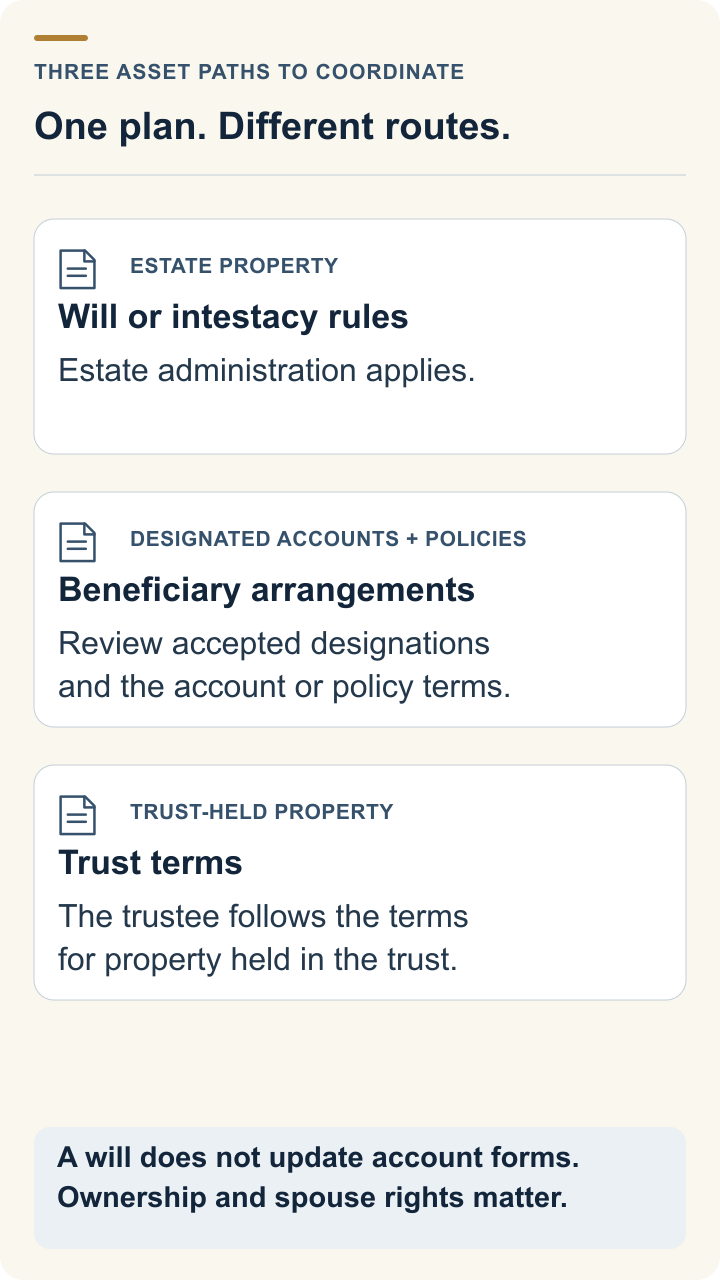
A well-written will cannot repair every outdated account form. Review life insurance, employer retirement plans, IRAs, annuities, and payable-on-death or transfer-on-death accounts separately.
For each account or policy, identify the current primary beneficiary, contingent beneficiary, percentages, and what happens if a beneficiary dies first. Then ask whether the recipient should receive the asset directly or through a legally appropriate trust or custodial arrangement. Naming a minor directly can require an authorized adult arrangement to receive and manage the proceeds; it does not authorize whichever relative you prefer to take the money informally.
Retirement accounts need their own analysis. Certain employer plans protect surviving spouses, and a nonspouse designation may require valid spousal consent. The IRS explains these protections in its retirement-plan death-benefit guidance. Retirement distribution and tax rules also differ by beneficiary and account; a trust should not be named automatically just because it is part of your estate plan.
Prior divorce orders or agreements may impose obligations involving insurance or retirement benefits. A qualified domestic relations order can assign rights in an employer plan to a former spouse or another eligible alternate payee. The U.S. Department of Labor’s QDRO guide explains why federal retirement rules must be considered alongside state family law.
Do not assume divorce automatically fixes every document. North Carolina has a rule addressing former spouses in wills under section 31-5.4, with stated exceptions. That is not a universal instruction to erase an ex-spouse from every policy or account. Review applicable law, plan requirements, and existing obligations before making changes.
Choose caregivers and money managers separately
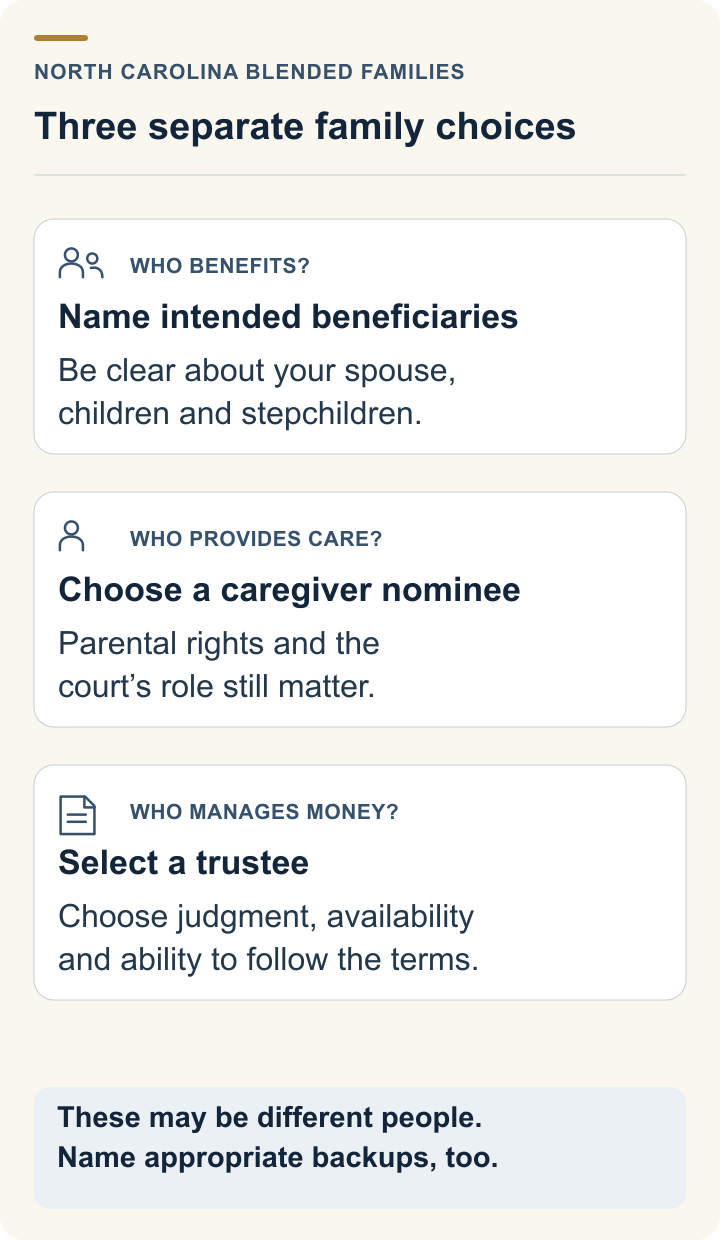
The person who would provide a child’s day-to-day care need not be the person managing that child’s trust. Separating those roles can help when a loving caregiver is not comfortable with investments, records, or distribution decisions.
A guardian nomination does not override a surviving parent
A parent can recommend a guardian in a will. Under section 35A-1225, the recommendation is a strong guide in the absence of a surviving parent, but the clerk is not bound to follow it if a different appointment serves the minor’s best interest.
Naming your current spouse, sibling, or friend does not by itself remove another legal parent’s rights. Section 35A-1224(d) specifically protects a surviving parent who has not willfully abandoned the minor. In a blended family, discuss existing custody orders, legal parentage, and realistic living arrangements. Estate planning is not a substitute for a custody determination or advice from family-law counsel.
Choose a trustee for judgment, not allegiance
A trustee should be able to follow instructions fairly, keep records, communicate, and manage competing requests. North Carolina requires a trustee with multiple beneficiaries to act impartially while giving due regard to their respective interests. See section 36C-8-803. Impartiality does not mean every beneficiary must receive the same amount at the same time.
A trusted relative, independent individual, or professional trustee may fit. Evaluate fees, availability, family relationships, and possible conflicts. A neutral trustee is not someone recruited to favor biological children over stepchildren or the spouse; the job is to carry out the plan’s actual terms.
Name backups and discuss how a replacement would be selected. Decide how the caregiver requests funds for school, medical care, activities, or a larger home. Our guide to protecting children’s inheritance explains support distributions, staged access, and continuing trusts in more detail.
Make the plan usable during life and after death
Blended-family planning also matters during an illness or incapacity. Financial and health-care authority should be addressed in the appropriate documents, with backups and clear access instructions. Do not assume being the spouse or oldest child answers every authority question.
Share enough information that decision-makers know their roles and where documents are kept. A short family conversation might explain: “These assets support the surviving spouse; these other assets are intended for the children; this person manages the children’s shares.” You do not necessarily need to disclose every balance or invite relatives to negotiate your choices.
Explain the reasoning behind sensitive choices when doing so is safe and useful. A letter can help people understand your intentions, but it should not contradict the controlling documents. Clear communication may reduce misunderstanding; it cannot guarantee agreement or prevent a challenge.
Revisit the plan after marriage, divorce, birth, adoption, a death, a move, a significant asset change, or a fiduciary’s changed circumstances. Keep a secure, current record of account ownership and beneficiary confirmations. A signed plan and a completed asset transfer are different things.
Common mistakes to avoid
- Treating an outright gift as a binding promise about the future. If later inheritance matters, put the intended structure into enforceable documents rather than relying on an informal understanding.
- Leaving stepchildren to interpretation. State who is included and address predeceased beneficiaries, descendants, future children, and changes in family relationships.
- Promising children a fixed inheritance from a fund available for spouse support. Model competing needs and explain whether principal may be spent.
- Ignoring asset ownership and account forms. A deed or beneficiary designation may send property somewhere different from the will.
- Confusing control with care. Review guardian nominations, surviving-parent rights, and trustee appointments as distinct questions.
- Assuming a trust bypasses spouse protections or has no administration costs. Legal rights, fiduciary work, and practical expenses still need attention.
Prepare for your planning conversation
Bring a family outline with names and ages, existing wills and trusts, marital or divorce agreements, relevant court orders, deeds, and a list of assets with ownership and beneficiaries. Approximate values are useful for the initial discussion. Also note who could serve as executor, agent, guardian nominee, and trustee—with backups.
Carolina Estate Plan offers virtual planning for North Carolina and South Carolina families. Trust-based plans generally range from $3,500–$5,500, with the scope and fee confirmed for your needs. The process generally involves two Microsoft Teams meetings, some homework, and mobile-notary help with signing, usually over four to six weeks.
Trust-based plans include the estate-planning documents, first-deed work for the primary residence, and detailed asset-by-asset funding instructions. You handle account retitling, beneficiary updates, and other institution-specific transfers. The service does not include having the firm contact institutions, complete or verify those transfers, or provide ongoing funding reviews. Additional property or specialized planning may require a different scope or appropriate outside counsel.
If you are weighing a will-based approach, our wills page explains its role. To discuss your household’s goals and whether our planning process is a fit, Request a free consultation.
Frequently asked questions
Do stepchildren automatically inherit in North Carolina?
Not from a stepparent merely because they are stepchildren. Unadopted stepchildren are not intestate heirs on that relationship alone. You can expressly include them through a will, trust, or appropriate beneficiary designation. Legally adopted children generally inherit from adoptive parents as other children do. A QTIP trust or tax election is not required simply to leave an inheritance to a stepchild.
Can I support my spouse while leaving an inheritance to children from an earlier relationship?
Yes. Possibilities include a trust with spouse-support and remainder provisions, direct gifts, or coordinated insurance and other assets. The plan must account for spouse rights, ownership, taxes, and administration. If the spouse can use trust principal, the amount left for children is not guaranteed.
Does a living trust let me avoid my spouse’s elective share?
Not automatically. North Carolina’s elective-share calculation can include revocable-trust assets and other nonprobate transfers. Marriage duration, statutory asset definitions, property passing to the spouse, and any valid waiver matter. This requires individual legal analysis rather than a generic “put it in a trust” solution.
Can my will appoint my new spouse instead of my child’s other parent?
A will can recommend a guardian, but the nomination does not itself override a surviving legal parent’s rights or an existing custody order. In the absence of a surviving parent, the recommendation guides the clerk, who still considers the child’s best interest. Discuss your custody and parentage circumstances before choosing nominees.
Should the same person be guardian and trustee?
Not necessarily. A caregiver may be excellent at raising your child but prefer someone else to manage the money. Separate roles can provide complementary skills, while also requiring good communication. Choose people who can cooperate, follow your instructions, and serve reliably; name backups for each role.
This North Carolina-focused guide provides general educational information, not advice for a particular family. Laws, account rules, and family circumstances can change. Confirm the current rules and your documents with appropriate counsel before acting. South Carolina rules require a separate analysis.


