
Ryan's take on revocable living trusts
A trust is most helpful when it is part of a full plan, not when it sits empty in a binder. The legal document matters, but funding the trust and coordinating beneficiary designations are what make the plan work when a family actually needs it.
Ask Ryan about your plan →What a living trust can do for your family
A revocable living trust lets you set rules for managing assets during your lifetime and for the people who inherit them. For parents, that can mean money available for a child’s care and education without handing over the entire inheritance at a young age. Assets properly held in the trust generally pass outside probate; the trust does not automatically cover everything you own.
Two decisions deserve separate attention: who would raise your children, and who would manage their inheritance? A guardian nomination belongs in the appropriate estate-planning documents and remains subject to applicable law and the court’s decision. A trustee manages trust property under the instructions you establish. The best caregiver and the best money manager can be different people.
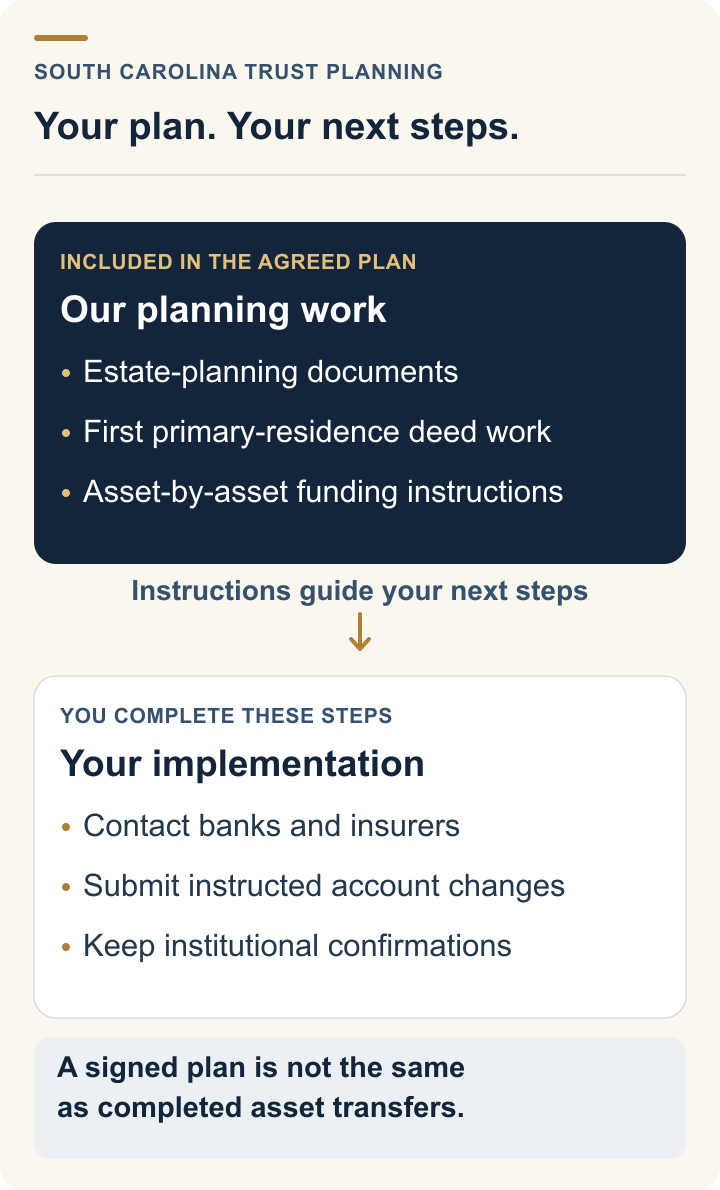
Carolina Estate Plan’s trust-based plans generally range from $3,500–$5,500. The process typically takes 4–6 weeks, with two Microsoft Teams meetings, some homework, and mobile-notary assistance for in-person signing. Plans include the trust and companion estate-planning documents, deed work for the primary residence—the first deed—and detailed asset-by-asset funding instructions. Your written engagement defines the scope.
You complete the institution paperwork, account retitling, beneficiary changes, and other transfers described in those instructions. The service is attorney-guided planning, not a promise that the firm funds every asset for you.
Start with the steps to set up a South Carolina living trust or see costs and included documents.
What a complete trust-based estate plan contains
A trust agreement is the center of the plan, not the entire plan. The documents need to work together so the right person has the right authority when it is needed.
The trust agreement
The agreement identifies the trustees, beneficiaries, shares, and distribution instructions. It can provide for support while a child is young, later outright distributions, or continuing management. The instructions should also address backups, a beneficiary’s death, and circumstances that warrant different treatment. An age-based distribution is a choice to discuss, not a default every family should adopt.
Pour-over will and guardian nominations
A pour-over will can direct appropriate probate assets into the living trust at death. Those assets still pass through probate first. It is a backstop, not a substitute for coordinating assets during life. A will can also include guardian nominations. Separately, a will-based plan can create a children’s trust; you do not need a living trust merely to delay an inheritance. The distinction is when the trust begins operating and how assets reach it.
Trustee succession and a certificate of trust
You can generally serve as your own initial trustee and name successors. The document specifies when a successor can act and how that transition is established. A certificate of trust gives institutions key information about the trust and trustee authority without routinely providing every distribution provision. An institution may still request appropriate supporting excerpts or transaction documents.
Financial and healthcare authority
A financial power of attorney addresses authority over assets and transactions outside the trustee’s role. Healthcare powers of attorney and living-will instructions address medical decisions; a trust does not authorize a trustee to make those choices simply because the trustee manages money.
Primary-residence deed work and funding instructions
The plan includes the first deed for your primary residence and detailed instructions for the relevant asset classes. Additional properties, unusual ownership arrangements, and deeds outside NC or SC require separate scope confirmation and may require other counsel. The instructions explain the client follow-through; they do not make the firm responsible for completing each institution’s transfer process.
How to set up a living trust in South Carolina
To set up a living trust in South Carolina, decide what the trust should accomplish, choose trustees and beneficiaries, have the terms drafted for your circumstances, sign the trust and companion documents correctly, and coordinate the appropriate assets with the trust. Signing and funding are separate steps. A signed agreement does not automatically change a deed or a bank’s beneficiary records.
1. Choose the people and the instructions
Identify who manages the trust now, who takes over if that person cannot serve, and who ultimately benefits. Parents should consider both financial support before adulthood and the timing of outright control. Discuss backups and whether the trustee can work constructively with the children’s caregiver.
2. Gather ownership and beneficiary information
Before the design meeting, collect your existing estate documents, current deed, a practical asset list, and available beneficiary information for retirement accounts and life insurance. Include business interests and property in another state. You do not need to arrive with every decision made; the purpose is to identify what needs attention without assuming all assets should be transferred in the same way.
3. Draft and review a coordinated South Carolina plan
South Carolina’s trust-creation rules, §§ 62-7-401 and 62-7-402, address methods of creation, capacity, intent, beneficiaries, and trustee duties. The agreement should fit the family—not simply substitute names into generic distribution language. Review how it works with the will, financial power of attorney, healthcare documents, and existing ownership arrangements.
4. Complete document-specific signing requirements
Planning and review meetings can be remote. Our signing process uses in-person mobile-notary assistance, with applicable witness and acknowledgment requirements addressed for the documents being signed. A trust, a will, and a deed do not all share one execution rule. For example, SC § 62-2-502 sets writing, signature, and two-witness requirements for an ordinary will, subject to its stated exceptions. A notary does not replace required will witnesses.
5. Carry out the appropriate asset instructions
Ryan handles the included first-deed/primary-residence work and provides detailed funding instructions. You complete bank and brokerage forms, beneficiary updates, and other required transfers. Retirement accounts generally remain in the account owner’s name; their beneficiary choices need separate attention. Business transfers may require company approvals and tax advice from the relevant professionals.
6. Keep records and revisit decisions when life changes
Keep the signed documents accessible to the people who will need them, along with records of completed asset changes. Marriage, divorce, a birth, a death, a move, or a new property can affect the plan. Seek advice before assuming an old instruction fits a new situation. This is a practical reminder, not an included ongoing monitoring or funding-review service.
For more state-specific context, read the South Carolina estate-planning guide. To discuss your own plan, Request a free consultation.
How much does a living trust cost in South Carolina?
Carolina Estate Plan’s trust-based plans generally cost $3,500–$5,500. That is this firm’s range, not a claim about the statewide average or every South Carolina attorney’s fees. Ryan provides a flat-fee quote for the agreed scope before drafting begins.
Compare what each quote includes: the trust, companion documents, meetings, signing assistance, the number of deeds, and funding instructions. Our plans include the primary-residence first-deed work and detailed instructions; clients complete the other transfers and institution paperwork. Ask about recording charges, additional properties, unusual assets, and later changes in the written engagement rather than assuming they are all included.
The price to create a plan is also different from the cost to administer it after death. A trust does not eliminate future professional fees, tax obligations, or trustee work. See the firm’s flat-fee planning information for the offer and consultation path.
For a detailed comparison of fees and included work, read our South Carolina living trust cost guide.
How to actually get assets into the trust
Funding means aligning appropriate ownership and beneficiary arrangements with the plan. Different assets require different actions. Listing an account on a personal worksheet is not the same as changing the institution’s records, and signing a trust does not direct every asset to it.
| Part of the process | What the plan provides | Your follow-through |
|---|---|---|
| Primary residence | Included first-deed work within the written engagement | Supply accurate property information and complete the required signing steps |
| Bank and nonretirement brokerage accounts | Detailed asset-by-asset instructions and trust documentation | Submit institution forms and complete the appropriate account changes |
| Life insurance and retirement benefits | Instructions addressing beneficiary coordination and issues to discuss | Complete accepted beneficiary forms; obtain account-specific advice when needed |
| Business interests and other property | Instructions identifying relevant ownership and transfer considerations | Work with the institution, company, tax adviser, or other counsel on approvals and transfers |
| Later accounts or changed circumstances | The instructions supplied with the plan | Check whether new advice or a separately scoped engagement is needed |
The firm does not provide institution letters, a funding-completion checklist service, verification that all assets are funded, or ongoing funding reviews. Keep your own institution confirmations. If a bank or other provider cannot follow an instruction, seek clarification instead of improvising a different ownership arrangement.
Real estate
Transferring a home involves an appropriate deed and applicable execution and recording requirements. A deed conveying property to a trustee is not the same thing as a mortgage “deed of trust.” Existing ownership, co-owners, financing, title insurance, and property-specific issues matter. Do not assume every transfer leaves a mortgage, exemption, or tax treatment unchanged.
Our included deed work is for the first deed/primary residence. For a family with an SC home and an NC vacation property, both properties deserve attention, but the second property is not automatically included. Property outside NC or SC may need counsel licensed where it is located. A properly completed trust transfer can help avoid separate probate for that property; an uncompleted transfer cannot.
Bank and brokerage accounts
For a nonretirement account, the instructions may call for trust ownership or another arrangement suited to the plan. Contact the institution about its forms, naming conventions, identification requirements, and effect on existing services. A certificate of trust can establish trustee authority, but it does not itself retitle the account. You are responsible for submitting the paperwork and keeping the institution’s confirmation.
IRAs, 401(k)s, and other retirement accounts
Do not retitle or withdraw retirement funds merely because you created a living trust. These accounts generally remain in the owner’s name, with beneficiary designations addressed separately. Naming a spouse, a child, or a trust can have different distribution and tax consequences. The IRS explains that beneficiary rules depend on the beneficiary and plan. Get account-specific advice before making a change; generic funding instructions are not a retirement-distribution strategy.
Life insurance
A trust can be considered as a primary or contingent beneficiary so proceeds reaching it follow its management instructions. That is different from changing the policy’s owner. For parents, review who receives proceeds if both parents die and who can manage money for minor children. Special-needs circumstances require tailored advice. You make the approved designation through the insurer; the firm does not submit or verify the beneficiary change. For NC parents, our life insurance and minor-beneficiary guide compares direct beneficiaries, custodians and trusts.
Business interests, vehicles, and other assets
LLC interests, partnership interests, and shares may be subject to transfer restrictions, lender requirements, or tax rules. S-corporation ownership in particular needs qualified tax and legal review. Ryan does not handle company approvals, lender consents, or business-transfer coordination as an included funding service. You arrange the required work with the appropriate professionals.
Vehicles, boats, tangible property, and digital assets also need asset-specific treatment. Do not assume a transfer-on-death option exists for every asset in either state. Account agreements and safe access arrangements can matter as much as title. The trust-funding guide explains the distinction between instructions and completed transfers in more detail.
NC & SC Legal Requirements
North Carolina trust law
North Carolina’s §§ 36C-4-401 and 36C-4-402 govern creation methods and core requirements. Revocation and amendment must follow the trust and § 36C-6-602. A written estate-planning trust, its companion will, and a property deed should each receive the required signing treatment; there is no safe universal “just notarize everything” shortcut.
Trustees have duties of good-faith administration, loyalty, prudence, and information-sharing under Chapter 36C. Administration is generally outside continuing court supervision, but § 36C-2-201 expressly allows court involvement. Privacy is therefore a qualified benefit, not a promise of permanent secrecy.
South Carolina trust law
The South Carolina Trust Code addresses creation in §§ 62-7-401–402, amendment and revocation in § 62-7-602, trustee duties in §§ 62-7-801–804, and beneficiary information in § 62-7-813. Section 62-7-401 includes particular writing rules for declarations and real-property trusts. Separate transfer and recording requirements still matter.
Section 62-7-201 recognizes trust proceedings in court even though ordinary management need not involve continuing court approval. A trust also does not automatically defeat a surviving spouse’s rights. If protecting children from a prior relationship is a goal, review the distribution plan and spousal rights together rather than assuming the trust’s label resolves the issue.
Will vs. Revocable Living Trust — How They Compare in NC
This is a North Carolina planning comparison, not a South Carolina probate-fee schedule. The useful question is what each plan needs to accomplish—not whether one document is universally better.
| Planning question | Will-based plan | Revocable living trust-based plan |
|---|---|---|
| When does it operate? | The will directs property governed by it at death | The trust can manage properly coordinated assets during life and after death |
| Can it manage a child’s inheritance? | Yes; a will can create a children’s trust | Yes; the living trust can provide continuing management or later distributions |
| Can it nominate a guardian? | A parent can recommend a guardian in a will, subject to the court’s decision | Trustee selection manages money; guardian nominations remain a separate decision |
| What happens to probate assets? | They follow the applicable estate process | Assets properly held in the trust generally avoid probate; a pour-over will’s probate assets do not |
| What if you become incapacitated? | The will is not an incapacity-management document; other authority is needed | A successor trustee can manage trust property when the required conditions are met; other documents still matter |
| How private is administration? | Probate filings create public records | Generally more private, with beneficiary disclosure duties and possible court proceedings |
| What work and expense remain? | Preparation, signing, and later administration as applicable | Preparation, signing, appropriate asset coordination, and later trust administration as applicable |
North Carolina expressly recognizes creation of a trust by will under § 36C-4-401. Its guardian-recommendation statute, § 35A-1225(a), makes the parent’s recommendation a strong guide when no parent survives, not an appointment guaranteed by the document.
For a deeper NC decision guide, see will versus living trust in North Carolina. For South Carolina’s distinct rules, use the SC estate-planning guide. Neither plan guarantees a fixed probate saving or removes every future administrative cost.
Who needs revocable living trusts
A living trust can be worth considering when ongoing asset management or inheritance instructions matter to your family. Parents with young children are one example, but homeowners, blended families, older couples, and adults planning for incapacity can have different reasons to consider the same tool.
A parent example—not a recommended default: Suppose two parents with children ages four and two choose a trusted relative as caregiver and a different relative as trustee. Their instructions could allow the trustee to pay appropriate education, healthcare, and living expenses while delaying outright distributions. They might discuss distributions at 25 and 30, or prefer continuing trustee management instead. The plan should say what happens if the chosen trustee cannot serve and how decisions are made for each child’s needs. The ages alone do not create a workable plan.
For a blended family, the discussion may center on supporting a surviving spouse while preserving something for children from an earlier relationship. For an older couple, successor management during incapacity may be more important than age-based distributions. For a homeowner with property in two states, the property-transfer work deserves particular attention. None of these situations makes a trust mandatory; each identifies a decision the plan should address.
Explore managing your children’s inheritance and estate planning for young families. Those resources explain family decisions without treating every child’s needs as the same.
5 mistakes to avoid
- Treating the signed trust as proof of funding. Check the actual deed, account title, and beneficiary records. Instructions and completed transfers are different things.
- Transferring retirement accounts like ordinary bank accounts. Ownership, beneficiaries, taxes, and inherited-account distribution rules need separate treatment. Do not withdraw funds to “put them in the trust.”
- Choosing a trustee only because that person is the guardian. Consider organization, judgment, availability, communication, and backups. Managing records and distributions is a different job from raising a child.
- Leaving conflicting instructions in place. The will, trust, ownership arrangement, and beneficiary form can direct different assets differently. A pour-over will does not override every beneficiary designation or prevent probate for assets passing through it.
- Assuming the trust is a tax or creditor shield. Your own revocable trust does not protect its property from your creditors. Beneficiary protections have limits, and tax treatment depends on the relevant rules—not simply on calling an arrangement a trust.
When a Revocable Trust Is the Wrong Choice
When a will-based plan may fit
Some families can meet their goals with a will-based plan, appropriate beneficiary designations, and incapacity documents. A will can create a trust for children, so inheritance timing alone does not settle the living-trust question. Compare the family’s assets, likely administration, management needs, up-front work, and willingness to follow through.
Do not rely only on an account balance or the fact that you own one home. Beneficiary-designated assets may avoid probate but still need a suitable recipient and management arrangement. A minor child or beneficiary receiving needs-based benefits can change the analysis. The goal is an appropriate plan, not the longest document package.
When specialized planning is needed
A revocable trust is not a stand-alone solution for Medicaid eligibility, estate-tax reduction, or shielding your own assets from creditors. An irrevocable trust is not an automatic solution either. Its terms, retained interests, timing, transfers, and applicable law determine the consequences.
Ryan’s focus is revocable living trust and will-based planning. A beneficiary with a disability, potential long-term-care eligibility issue, or sophisticated tax problem may need specialized advice or a referral. Read the special-needs planning overview as background, not as assurance that a generic trust preserves benefits or that every specialized service is included here.
The honest test
What problem are you trying to solve, who needs authority, and what work must actually be completed? Those questions are more useful than assuming every family needs a trust or that every trust avoids all court involvement. Start with the goals; then choose the documents and asset arrangements that serve them.
Common questions about revocable living trusts
Can I be my own trustee and change the trust later?
Generally, yes. You can serve as initial trustee of your revocable living trust and name successors. Amendments and revocation must follow the agreement and applicable law; joint trusts can involve different rights for each person. The plan should explain when a successor takes over rather than promising that authority changes automatically whenever a relative believes it should.
Does a living trust avoid probate in NC or SC?
Assets properly held in a living trust generally pass outside probate in either state. That does not mean every asset you own is covered or that administration is immediate. Assets directed into the trust by a pour-over will still pass through probate. Creditor claims, taxes, trustee duties, and possible court proceedings can remain.
Can a will protect my children’s inheritance without a living trust?
Yes. A will can create a trust for children and direct how the trustee manages distributions. A living trust offers a different structure that can also operate during life and receive appropriately coordinated assets outside probate. Choosing between them involves your assets and management goals—not a claim that children must receive everything at 18 unless you buy a living trust.
Should the guardian and trustee be the same person?
They can be, but they do not have to be. A caregiver’s strengths may be different from those needed to manage investments, paperwork, and distributions. Discuss willingness, location, time, financial judgment, and communication. Choose backups too. The trust handles property management; guardian nominations and any appointment remain subject to the applicable law and court process.
Does a revocable trust protect assets from creditors or eliminate taxes?
No general protection or tax elimination follows from a revocable trust. NC § 36C-5-505 and SC § 62-7-505 allow creditor access to a settlor’s revocable-trust property. Proper beneficiary spendthrift provisions can limit some access before distribution, with exceptions. Revocable-trust income is generally attributed to the owner under grantor-trust rules; tax-saving claims require separate analysis.
Does Ryan transfer all of my assets and update my beneficiaries?
No. Trust-based plans include primary-residence first-deed work and detailed asset-by-asset funding instructions. You complete account paperwork, beneficiary changes, and other transfers. The firm does not provide institution letters, a completion-checklist service, funding verification, or ongoing funding reviews. Extra property work or specialized issues require separate scope confirmation.
Can my trust own business interests or property in another state?
It may be appropriate, but neither is an automatic transfer. Business agreements, tax eligibility, and required approvals need review by the relevant professionals; the client arranges business-transfer coordination. Real estate must satisfy the law where it is located. Additional deeds are not automatically part of the primary-residence first-deed scope, and property outside NC or SC may require other counsel.
Does a trust need its own EIN or an annual tax return?
Not every trust has the same tax-reporting requirements. Many revocable grantor trusts use permitted reporting methods tied to the owner’s taxpayer information. Death, multiple owners, a change in trust status, income, and beneficiary circumstances can affect EIN and return requirements. Use the IRS Form 1041 instructions and qualified tax advice; do not assume “never a return during life” or “a return every year after death” applies universally.
What happens if I become incapacitated or move to another state?
A successor trustee can manage trust assets when the conditions in the trust and applicable law are satisfied. Financial powers of attorney and healthcare documents address other needs. After a move, seek review of the plan, local execution issues, property, and beneficiary arrangements before assuming everything carries over unchanged. That is not a promise of included ongoing review services.
How much time will this take, and do I have to visit an office?
The usual process is two Microsoft Teams meetings, homework between stages, and in-person signing with mobile-notary assistance, typically over 4–6 weeks. That is a typical planning timeline, not a guarantee that every institution will complete funding changes in that period. Trust-based plans generally range from $3,500–$5,500, with the agreed work and payment terms in the written engagement.
Official references and statutes
The explanations above draw on the North Carolina Uniform Trust Code, South Carolina Trust Code, and IRS explanation of grantor trusts. This is general educational information, not advice for a particular family. The right documents, signing steps, and asset instructions require individual review.
Start your estate plan today
You do not need to arrive knowing every trustee choice or distribution age. Bring the questions that are keeping the plan on your to-do list. Ryan can help you compare a will-based and trust-based approach and identify the work your family actually needs.
Request a free consultation. Learn more about attorney Ryan Duffy and the virtual planning process.
Trust and family protection guides
Choose the next guide based on the question you want to resolve. These family guides describe North Carolina law; use the South Carolina guide for SC-specific rules.
- Start with the young-family planning guide for guardians, incapacity documents, and coordinating the plan.
- Choose trustees and inheritance-distribution terms when your main concern is who manages the money and when children receive control.
- Explore blended-family estate planning when balancing a spouse’s needs and children from an earlier relationship.
Related practice areas
Your plan may also involve a will, financial power of attorney, healthcare instructions, and ancillary documents. Explore probate planning and flat-fee pricing without assuming the trust replaces every other document.