Medicaid Planning in NC: A Family Guide to Care Costs
September 27, 2026 · Ryan P. Duffy


Medicaid planning in North Carolina is not as simple as putting a house in a trust and waiting five years. Long-term-care coverage depends on the program, care needs, income, resources, transfers, and sometimes a spouse’s circumstances. An ordinary revocable living trust is not a Medicaid asset shield.
If you are raising young children while helping an aging parent, the useful first step is to separate the problems: paying for care, making decisions during incapacity, and understanding what may happen to property later. This guide explains the questions to take to a qualified Medicaid-planning adviser; it is not a promise of eligibility or a description of specialized Medicaid services offered by this firm.
Start with the care need and the coverage program
Medicare and Medicaid serve different purposes. Medicare can cover qualifying skilled nursing, home-health and other services when its conditions are met. It generally does not pay for long-term custodial care simply because someone needs help bathing, dressing or eating. The distinction is explained in Medicare’s long-term-care coverage guidance.
Medicaid may cover eligible long-term services, but financial eligibility alone is not enough. The person must satisfy the applicable care and program requirements. A family’s first conversation should identify whether the immediate need is short-term rehabilitation, ongoing nursing-facility care, or support at home, then confirm which benefits actually cover it.
For a parent leaving the hospital next week, do not let a general five-year planning discussion postpone urgent benefit and care coordination. Ask the discharge team, county Department of Social Services, and an appropriately experienced adviser about the immediate application and placement issues.
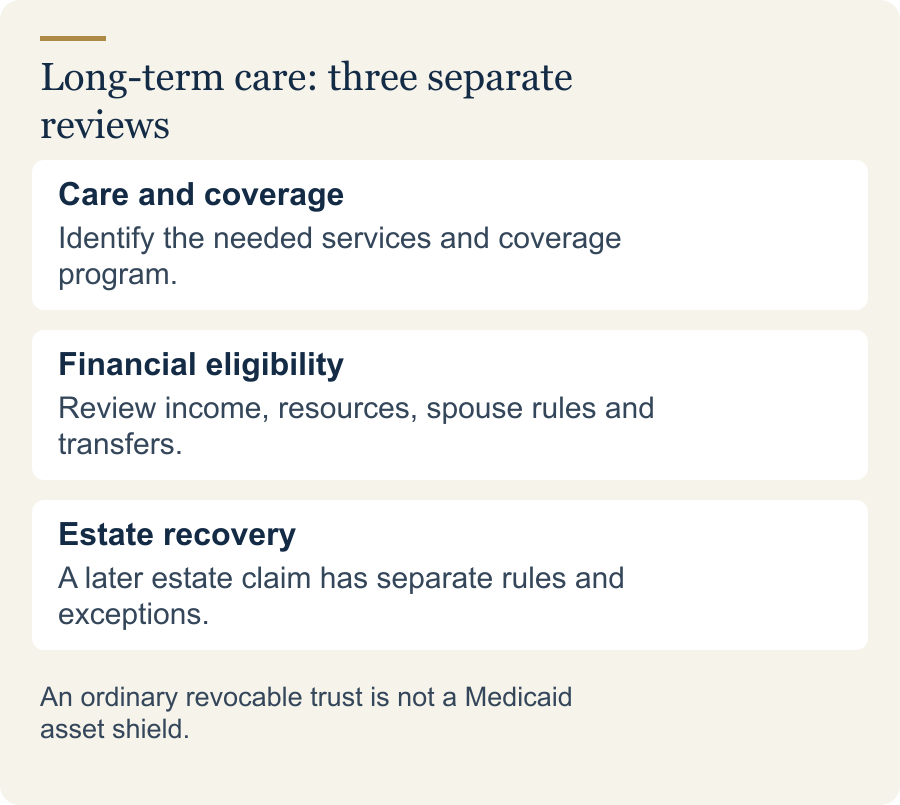
Read this diagram as text
Care and coverage: Identify the needed services and coverage program. Financial eligibility: Review income, resources, spouse rules and transfers. Estate recovery: A later estate claim has separate rules and exceptions.
Financial eligibility is more than a single asset limit
The treatment of an asset depends on its type, ownership and the program’s rules. A home may receive different treatment from an ordinary bank account, but “the home is exempt” is not a reliable universal answer. Home-equity limits, occupancy, intent to return, family circumstances and other conditions can matter. Exclusion for eligibility also does not necessarily prevent a later estate-recovery claim.
Prepare an inventory of accounts, real estate, insurance, retirement benefits, income, debts, and transfers. Include jointly owned property rather than assuming joint title removes an asset from review. Keep supporting statements and deeds, not only an approximate net-worth total. The agency may need evidence of the history and source of funds.
Income rules and resource rules are also different. Moving money between accounts does not necessarily solve either issue. Before selling property, adding an owner, buying a financial product or changing beneficiary arrangements, have the proposed step evaluated under the relevant program.
The 60-month lookback is not a blanket ban on gifts
Transfers for less than fair market value during the applicable 60-month lookback can cause a period of ineligibility for specified long-term-care services. There are exceptions and allowable transfers. The reason for the transfer, the recipient, retained rights and the evidence all matter. North Carolina’s MA-2240 transfer-of-assets manual explains these rules.
For example, some qualifying transfers to a spouse or a disabled child may receive different treatment. A caregiver-child home-transfer exception has specific requirements; being a helpful adult child does not establish it automatically. Obtain advice about documentation before a deed is signed.
A transfer penalty is not simply a clock that always begins on the gift date. Its start and duration depend on the governing rules and eligibility circumstances. This is why a gift shortly before an application can create a serious gap in payment for care. A federal gift-tax annual exclusion does not make the same gift harmless for Medicaid.
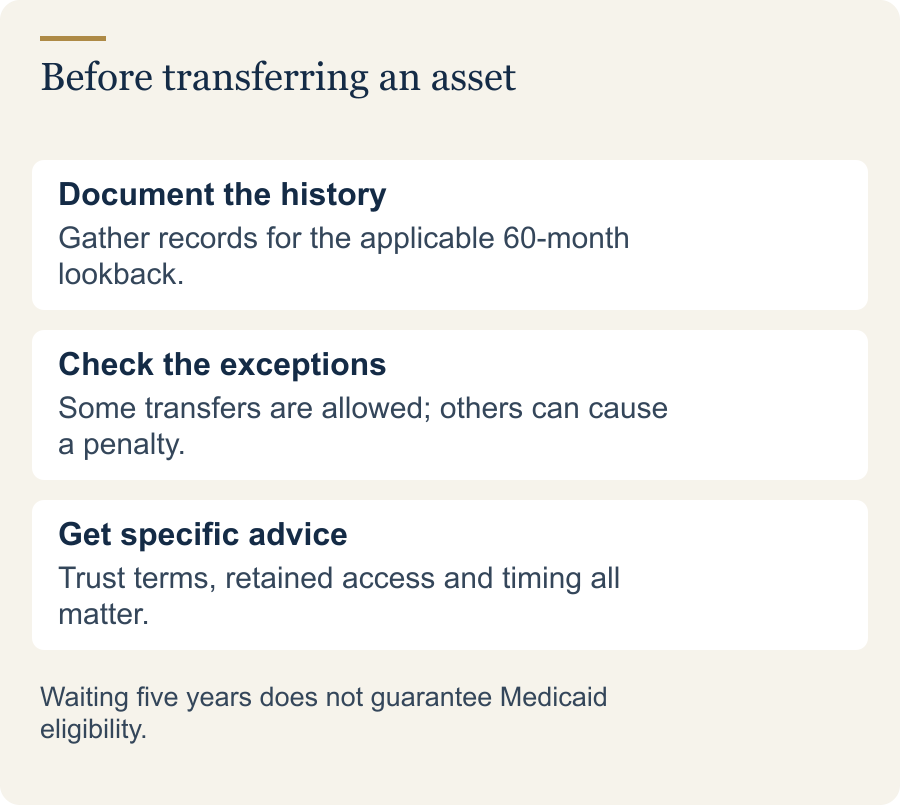
Read this diagram as text
Document the history: Gather records for the applicable 60-month lookback. Check the exceptions: Some transfers are allowed; others can cause a penalty. Get specific advice: Trust terms, retained access and timing all matter.
What can a spouse keep in 2026?
Spousal-impoverishment rules are intended to protect a qualifying spouse who remains in the community. For 2026, federal standards list a $32,532 minimum and $162,660 maximum community spouse resource allowance. These are boundaries used in an assessment, not an automatic entitlement for every applicant. See the CMS 2026 spousal-impoverishment standards and North Carolina’s MA-2231 resource-protection manual.
North Carolina’s basic spousal allowance became $2,705 per month effective July 1, 2026, according to Change Notice 08-26. The actual income allowance depends on the calculation, including the community spouse’s income and applicable adjustments and limits. It is not a guaranteed additional monthly payment.
These figures are time-sensitive. A couple should have the current assessment performed rather than transfer everything based on a blog’s maximum number. Ask which assessment date applies, how jointly held resources are treated, and what evidence the agency requires.

Estate recovery is a separate question—not an automatic lien
North Carolina’s MA-2285 estate-recovery manual describes recovery of certain Medicaid payments through a claim against a deceased beneficiary’s estate. It expressly distinguishes that process from placing a lien on property. Describing every protected home as becoming subject to an automatic “Medicaid lien after death” is inaccurate.
Recovery depends on the services, age and other applicable requirements. Surviving-spouse, child-under-21, and blind or disabled child circumstances can affect recovery. The manual also provides for qualifying hardship and other limitations. Some protections are deferrals: recovery may resume when the grounds for deferral end, rather than disappearing permanently.
If an estate receives a recovery notice, preserve it and obtain advice promptly about the claim, exceptions and response procedures. Do not assume an asset’s eligibility treatment answers the recovery question, and do not transfer estate property before understanding the representative’s duties.
Where trusts and ordinary estate planning fit
A revocable trust generally preserves access and control for its creator. That flexibility is useful for family inheritance and incapacity planning, but it ordinarily does not exclude those assets for Medicaid purposes. An irrevocable trust requires a separate examination of its terms, retained benefits, transfer timing and the other eligibility rules. Five years passing does not guarantee protection.
Ordinary planning still matters: financial powers of attorney, healthcare agents, accessible records, and appropriate wills or trusts can make it easier for trusted people to help. Authority under a power of attorney is not unlimited, especially for gifts or trust changes. The document and applicable law must authorize the actual transaction.
Our revocable-trust planning and funding guidance should not be confused with a specialized Medicaid eligibility strategy. Trust-based plans include agreed first-deed/primary-residence work and detailed instructions; clients handle other institution steps and transfers. Specialized Medicaid advice and representation require a separately confirmed engagement with a suitably experienced professional.
Questions to bring to a Medicaid-planning consultation
- What care is needed now, and which program could cover it?
- Who can legally make financial and healthcare decisions?
- What property, income and transfers must be documented?
- Does a spouse or another protected family member affect the analysis?
- Could a proposed transfer cause a coverage gap or other tax consequences?
- How would estate recovery apply, and what exceptions require evidence?
For the adult child coordinating everything, assign one place for notices, statements and contact details. Involve the parent in decisions to the extent possible, and avoid treating a sibling’s informal promise as a substitute for legal authority.
Frequently asked questions
Does Medicare pay for a permanent nursing-home stay?
Not simply because long-term custodial care is needed. Qualifying skilled-care coverage is different and has its own conditions and limits.
Can my parent give me the house and immediately qualify?
Do not assume so. A transfer can create a penalty unless an exception or other rule applies. Review the circumstances and documentation before changing title.
Does an ordinary living trust protect assets for Medicaid?
Generally no. Retaining access through a revocable trust is not the same as satisfying Medicaid resource and transfer rules.
Should we wait until care is unavoidable to ask for help?
No. Earlier advice allows more time to understand options. If care is already urgent, get situation-specific help now rather than assuming no options remain.
Keep your own family’s plan moving
Helping a parent often reveals gaps in your own documents. For ordinary NC or SC estate planning, complete our consultation qualification form. For Medicaid eligibility, applications or recovery disputes, seek specifically qualified advice and confirm the professional’s scope. This guide is general education, not an eligibility determination.


Related estate planning guides
Use these next if you are comparing wills, trusts, probate avoidance, and the cost of a complete plan.
Have questions about your estate plan?
Ryan P. Duffy is a North Carolina and South Carolina licensed estate planning attorney. Schedule a free, no-pressure consultation to discuss your family's specific situation.
Schedule Your Free Consultation