


Naming your children as life-insurance beneficiaries does not, by itself, answer who can manage the money while they are young—or when they receive unrestricted control. For North Carolina parents, the useful comparison is a child named directly, a properly designated UTMA custodian, or a trustee under a coordinated trust plan. Each can benefit your children, but they solve different problems.
If your goal is “help with school and everyday life now, but do not hand over a large balance at 18,” the beneficiary designation and the trust terms need to work together. Signing a trust alone does not update a policy.
This guide addresses North Carolina estate-planning decisions, not how much insurance to buy or which insurance product to choose. South Carolina rules and individual policy requirements can differ.
Can a minor child be a life-insurance beneficiary in NC?
A child can be named as a beneficiary and can have a legal interest in the proceeds. The problem is receipt and management, not a blanket rule that children cannot own property or inherit.
An insurer must determine who has authority to receive payment for a minor. A surviving parent or the person raising the child is not automatically the legally authorized manager of every asset payable to that child. The policy, designation, amount, and available legal arrangement matter.
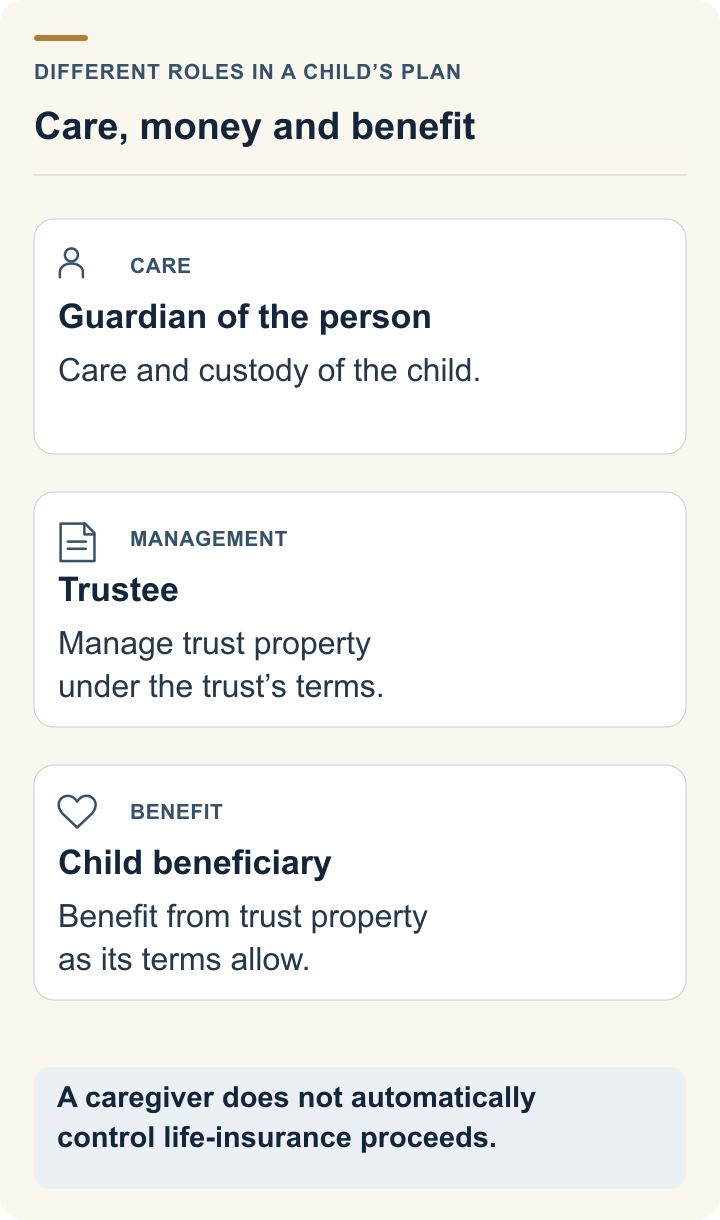
One possible route is a court-appointed guardian of the estate. North Carolina distinguishes that financial role from a guardian of the person, whose responsibilities concern care and custody. A general guardian fills both roles. See G.S. 35A-1202(7), (9), and (10).
Financial guardianship brings administration, not simply a parent receiving a check. Bond requirements, subject to applicable exceptions, and inventories are part of that framework. A minor’s guardian must seek prior court approval for expenditures from principal under G.S. 35A-1252(9). Minor guardianship ordinarily ends at adulthood, with final accounting responsibilities continuing until discharge; it is not a tool for delaying an inheritance to 30. See G.S. 35A-1295.
Court-appointed guardianship is not inevitable in every case. Proper custodial designations and other statutory payment arrangements may offer alternatives. Planning before a claim arises gives your family more control over the route.
Compare a child, UTMA custodian, and trust
Start with two questions: Who should manage the proceeds, and how long should that management continue?
| Arrangement | Who manages the benefit? | When does the child receive control? | Main tradeoff |
|---|---|---|---|
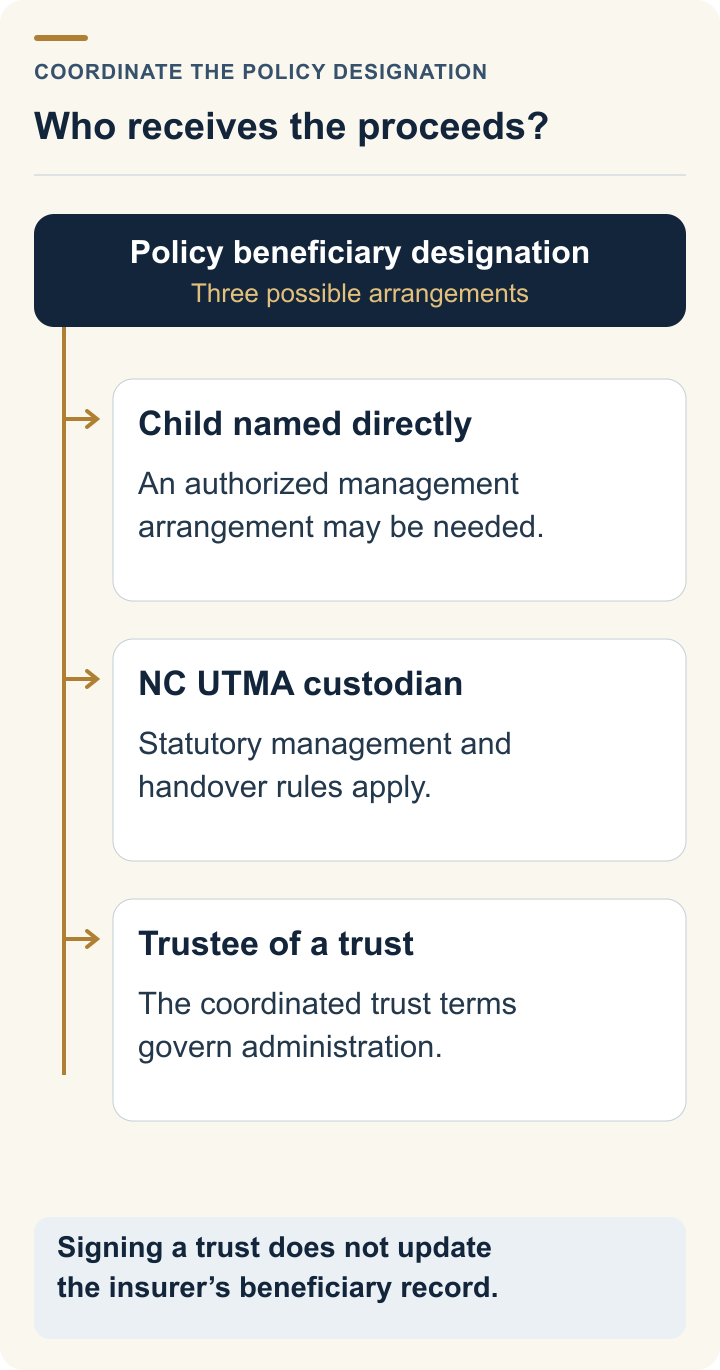
| Child named directly, without a coordinated management arrangement | An authorized recipient must be established; a guardian of the estate may be needed | A minor guardianship ordinarily ends when minority ends, rather than at a parent-selected later age | Simple beneficiary entry, but potential court administration and limited control over adult access |
| Properly designated NC UTMA custodian | The named custodian manages the child’s custodial property | The applicable statutory termination rule controls; certain transfers end at 18, others at 21, with a limited earlier-transfer option | Often simpler than a custom trust, but cannot provide open-ended, parent-selected adult distribution terms |
| Trustee of an appropriately drafted trust | The trustee administers the proceeds for the named beneficiaries under the trust | The trust can specify later distributions, stages, or continuing management, subject to law | More design and administration, but greater ability to coordinate support, backup management, and inheritance timing |
There is no universal dollar threshold at which every family must choose a trust. Compare the likely benefit with the children’s ages, the manager’s responsibilities, and your comfort with the applicable handover age. A smaller benefit may still need careful planning when a child has a disability or a difficult family situation.
NC UTMA: understand the age-18 and age-21 distinction
The North Carolina Uniform Transfers to Minors Act allows an adult to hold and manage property for a child without creating a custom trust. It is not merely naming an adult and hoping that person uses the money well. A proper custodial designation identifies the adult’s legal capacity and the particular child.
G.S. 33A-3 permits nomination of a custodian for property payable upon a future event, including through a written beneficiary designation delivered to the contractual payor. It also permits substitute custodians. The insurer’s form must support the arrangement; obtain its requirements rather than copying a generic designation from an article.
It is not always “the child gets it at 21”
G.S. 33A-20 ties termination to the legal route of the transfer:
- Property transferred under G.S. 33A-4 or 33A-5 generally transfers to the child at 21. The statute permits a transferor’s specified earlier age after 18 and before 21.
- Property transferred under G.S. 33A-6 or 33A-7 transfers at 18.
- The child’s earlier death also ends the custodianship, with property going to the child’s estate.
A direct insurer payment under the obligor provision, G.S. 33A-7, therefore should not be described as automatically creating age-21 protection. Have counsel identify the route that your actual arrangement uses.
The $10,000 rule also needs context. Under G.S. 33A-7(c), a fallback transfer when no nominated custodian is available is limited to $10,000 in aggregate value and specified recipients. That is not a general $10,000 ceiling on every properly planned UTMA arrangement.
The money belongs to the child
Once transferred, custodial property is irrevocably vested in the child under G.S. 33A-11(b). The custodian may use it for the child’s benefit under the statutory rules, but cannot treat it as personal money or casually redirect it to a sibling. A custodianship is for one minor, not a pooled family pot. See G.S. 33A-10 and G.S. 33A-14.
Practical takeaway: UTMA may be a useful fit when you accept its statutory handover rules. If you want management well beyond those ages, discuss a trust rather than expecting a custodian to keep control informally.
A trust can provide support before an outright inheritance
Delaying unrestricted control does not have to mean withholding help. A children’s trust can authorize a trustee to pay permitted expenses while retaining the remaining balance under management.
For example, properly drafted terms could allow education, health, and other support expenses during childhood and young adulthood, followed by staged distributions. Another family may prefer a continuing trust rather than an automatic payout at a particular birthday. These are design choices—not default features of every document called a “family trust.” The trustee must administer the trust in good faith under its terms and applicable law; see G.S. 36C-8-801.
Discuss concrete situations: summer childcare, therapy, transportation, college, vocational training, or a first apartment. Decide how much judgment the trustee should have and whether the trust should pay providers directly or make permitted reimbursements. Clear powers matter more than a vague instruction to “take care of the kids.”
Also decide whether each child has a separate share immediately or whether a common fund supports the children for a period. Equal dollar distributions and fair support are not always the same thing when one child is 4, another is 2, and their needs differ.
Your children’s guardian and trustee can be different people. A sibling may be the best caregiver while another trusted adult is more comfortable with records and investments. Their responsibilities need to work together; appoint backups and discuss willingness to serve. A will’s guardian recommendation guides the court but does not override every circumstance or a surviving parent’s rights. See G.S. 35A-1225(a).
For distribution ages and trustee-selection questions beyond insurance, see how to protect your children’s inheritance with a North Carolina trust.
Primary versus contingent beneficiaries: test both scenarios
A primary beneficiary is first in line under the designation. A contingent beneficiary is a backup if the conditions for that beneficiary to receive the proceeds are met. Exact survivorship requirements, shares, and payment rules come from the policy, designation, and applicable law.
“My spouse is primary, so the children are covered” addresses only part of the plan. You need to consider both the first parent’s death and the possibility that the spouse cannot receive the benefit.
| Scenario to test | What to clarify | Why it matters |
|---|---|---|
| You die and your spouse qualifies to receive the benefit | Is the spouse receiving it outright or through a trust, and does that match the intended access? | An outright payment belongs to the spouse; a contingent children’s trust does not control that payment |
| Your spouse dies before you | Who is next in line, in what shares, and with what management arrangement? | A backup naming children directly can reintroduce the minor-beneficiary problem |
| Both parents die in the same event or close together | How do the policy and applicable survivorship rules determine eligibility? | Do not assume the contingent designation always controls without checking those rules |
| One named child dies before the insured | Does that share go to surviving named beneficiaries, descendants, or another recipient? | A percentage alone may not express the family outcome you intend |
Naming a trust as primary may be appropriate when its terms need to govern the first payment. Naming a spouse as primary and a trust as contingent may fit a different objective. Neither structure is a universal recommendation. Compare access for the survivor with the controls you want for the children, including blended-family and prior-marriage concerns.
A worked example: two parents, two young children
Consider a hypothetical North Carolina family: Maya and Jordan are 38, their children are 4 and 2, and Maya has a $1.5 million policy. These are illustrations, not clients, insurance recommendations, or a prediction of claim results.
Version 1: Jordan is primary; the children are contingent, 50% each. If Jordan qualifies and receives the proceeds outright, Jordan controls them. If the contingent designation applies instead, the children may each be entitled to $750,000, assuming the entire stated benefit is payable and those shares apply. The designation has not supplied a custom long-term manager or later distribution ages. An authorized payment and management arrangement still must be established.
Version 2: Jordan is primary; a properly identified children’s trust is contingent. If Jordan receives the proceeds outright, the trust still does not control that payment. If the contingent trust receives them, its terms govern administration. A trustee could make authorized payments for the children’s needs while keeping the remaining balance under the chosen distribution terms.
Suppose the parents nominate Maya’s sister as guardian and Jordan’s brother as trustee. They should discuss how the trustee could pay an approved childcare bill, what records the guardian provides, and who decides disputed requests. Naming two people without describing the financial arrangement leaves avoidable uncertainty.
If Jordan later dies after receiving Maya’s benefit, those proceeds are now part of Jordan’s financial picture. Maya’s old contingent designation does not pull that money back into the children’s trust. Jordan’s own estate plan, accounts, and insurance arrangements must also be coordinated.
The lesson: test the plan person by person and policy by policy. A good backup is not a substitute for understanding what happens when the first-choice beneficiary receives the money.

Does a will or trust automatically update your policy?
No. Creating a will or living trust is separate from changing the insurer’s beneficiary record. Do not assume a pour-over will or a funding-instructions document overrides an existing designation.
North Carolina expressly recognizes a trustee’s interest as a life-insurance beneficiary as sufficient to support a living or testamentary trust. That is legal support for a coordinated arrangement, not an automatic change to every policy you own. See G.S. 36C-4-401.1(a).
What about a trust created in your will?
A testamentary trust can be part of an insurance plan; it is not categorically necessary to create a living trust. But the designation, will, and trustee’s claim must fit together.
G.S. 36C-4-401.1(c) permits designation of a trustee named or to be named in the insured’s will. It also provides that if no trustee claims the proceeds within six months after death, payment goes to the personal representative unless an alternative designation or the policy or plan provides otherwise. This specific rule is not a universal six-month claim deadline for all life insurance.
That administrative detail is a reason to coordinate the documents and tell the appropriate people where to find them—not a reason to select a trust type from a generic form.
The policy owner is not the same as the beneficiary
The insured is the person whose life the policy covers. The owner holds the policy’s contractual rights. The beneficiary is designated to receive the death benefit under its terms. One person can fill more than one role, but the roles are not interchangeable.
Changing a beneficiary to a trustee does not, by itself, transfer policy ownership to that trustee. North Carolina’s statute expressly recognizes an insurance-beneficiary trust even when the insured or another person retains specified ownership rights, including the right to change beneficiaries. That does not answer every tax or policy question.
An irrevocable life insurance trust, often called an ILIT, is a specialized arrangement with additional ownership, administration, and tax considerations. It is not simply another name for a revocable family trust listed as beneficiary. Do not transfer ownership or assume you need an ILIT based on this guide.
Likewise, do not apply life-insurance instructions wholesale to an IRA or 401(k). Retirement-beneficiary decisions have separate federal distribution and tax rules, including rules affecting trusts. For IRA-specific context, see IRS Publication 590-B. Each asset needs its own analysis.
What to decide with your attorney and confirm with your insurer
Before the planning meeting, gather each policy’s current beneficiary confirmation or designation, the owner and insured names, and any employer-plan information. Review each policy separately; a change to a personal policy does not update workplace coverage.
With your attorney, decide:
- Who needs access if one parent survives, and what should happen if neither survives.
- Who manages each child’s money, who serves as backup, and when unrestricted control should begin.
- Whether disability, public-benefit eligibility, divorce orders, or blended-family obligations require a different structure.
- Whether shares, successor beneficiaries, survivorship provisions, and the trust’s name and date align with the intended plan.
Then work directly with the insurer or benefits administrator to request its required form or process. Ask how it records a trustee or custodian, whether additional documentation is needed, and how to confirm the accepted primary and contingent designations. Retain the insurer’s written confirmation with your estate-planning records and compare it with the intended changes. If the confirmation is incomplete or different, resolve that discrepancy rather than assuming submission was enough.
These are client implementation steps, not a representation that Carolina Estate Plan makes or verifies policy changes. Our trust-based plans include first-deed work for the primary residence and detailed asset-by-asset funding instructions. Clients handle beneficiary changes, account retitling, and other transfers with their institutions. We do not perform those updates, provide institution letters, verify their completion, or provide ongoing funding administration. Read more about what trust-funding instructions cover.
Mistakes that can undo a good plan
Naming an adult personally “for the children.” Naming your sister outright is different from naming her in a legally defined fiduciary role. Do not rely on an informal promise to create the controls of a trust or custodianship.
Treating every UTMA as an age-21 account. The transfer route matters. Confirm it before relying on a particular handover age.
Selecting ages without support provisions. A delayed payout should not leave the trustee unclear about paying appropriate expenses in the meantime.
Ignoring backups and changed circumstances. A new child, divorce, death, move, policy replacement, or employer change can make an old designation a poor fit. Revisit the relevant documents and insurer records when circumstances change.
Expecting one form to replace a family plan. Insurance is one source of support. Guardian nominations, powers of attorney, health-care documents, and other assets still matter. Our estate-planning guide for young North Carolina families puts those pieces in context.
Planning help without another complicated project
You do not need to select every trustee power before asking for help. Begin with your priorities: who would raise the children, who should manage their money, and what a young adult should be able to control.
Carolina Estate Plan offers attorney-guided trust-based estate planning for North Carolina and South Carolina families. Trust-based plans generally range from $3,500 to $5,500, with scope and price confirmed for the engagement. The usual process is two Microsoft Teams meetings, some client homework, and approximately four to six weeks, with mobile-notary help for signing at home. Timing depends on the circumstances and completion of the necessary steps.
Request a free consultation to tell us about your family and planning goals. This article provides general North Carolina information, not individualized legal, insurance, or tax advice.
Frequently asked questions
Can I name my minor child directly as my life-insurance beneficiary?
Yes, but the designation alone does not establish who can receive and manage the proceeds for the child. A guardian, valid custodial arrangement, or other applicable payment route may be needed. Compare that result with your intended management and distribution timeline before making the designation.
Does a North Carolina UTMA always last until age 21?
No. G.S. 33A-20 provides different termination rules: transfers under G.S. 33A-4 or 33A-5 generally end at 21, with a specified earlier-after-18 option; transfers under G.S. 33A-6 or 33A-7 end at 18. The child’s earlier death also terminates the custodianship. Confirm which transfer provision applies.
Should my spouse or my trust be the primary beneficiary?
That choice should match access and control at the first death. An outright payment to a spouse is different from payment to a trustee under trust terms. Naming a trust only as contingent does not impose its rules on money paid outright to the spouse.
Can the trustee help my child before the final distribution age?
Yes, when the trust authorizes those payments. The document can separate support during childhood and young adulthood from unrestricted ownership later. Discuss permitted expenses, trustee discretion, and separate versus pooled shares instead of relying on an age provision alone.
Will signing my trust change my insurance beneficiaries?
No. You must follow the insurer’s beneficiary-change requirements and confirm the accepted designation. Carolina Estate Plan provides asset-specific instructions; clients make beneficiary changes and other institutional updates. The firm does not perform or verify those changes.


