


What does a living trust cost in South Carolina? At Carolina Estate Plan, trust-based plans generally range from $3,500 to $5,500. That is our firm’s range—not a statewide average—and it covers a coordinated estate plan, not simply a trust document. For parents with young children, the important comparison is whether the work addresses the people who would raise your children, the person who would manage their inheritance, and the instructions that person would follow.
Our process includes two Microsoft Teams meetings, homework between meetings, the estate-planning documents in your agreed plan, and mobile-notary signing. Plans usually take four to six weeks. First-deed work for the primary residence and detailed asset-by-asset funding instructions are included; you complete the account retitling, beneficiary changes, and other asset transfers described in those instructions.
This guide explains what is included, which funding steps you handle, and what to ask about additional costs. It also helps you compare a trust-based plan with a will-based alternative.
What our South Carolina trust-based plans cost
Our trust-based estate plans range from $3,500 to $5,500. Your written engagement agreement should identify the fee and scope that apply to your family. Do not assume the lower end is an automatic quote, that the upper end is a universal cap for every possible legal matter, or that this range describes other firms’ prices.
An apples-to-apples comparison includes both the documents and the work around them. A template subscription, a document-only attorney service, and an attorney-guided coordinated plan may answer different needs even when each offer uses the words “living trust.” None should be judged by its label alone.
For a parent, the practical question is: “Will this plan translate our decisions into usable instructions, and do we understand what we must do afterward?” Paying more does not itself prove better planning; paying less does not itself prove the documents are defective. Compare the actual deliverables and responsibilities.
For the firm’s broader pricing approach, see our flat-fee estate-planning information.
What a coordinated estate plan includes
A living trust is one part of a family’s plan. The trust sets out the terms for property held in it, including who manages that property and how beneficiaries may receive it. South Carolina recognizes several methods of creating a trust and specifies requirements such as capacity, intent, identifiable beneficiaries subject to statutory exceptions, and trustee duties. Those rules are in S.C. Code §§ 62-7-401 and 62-7-402.
The documents need to work together
Our trust-based service includes the estate-planning documents in the agreed plan. The planning conversation addresses the trust, supporting wills, financial decision-making authority, health-care decisions, and provisions appropriate for your children. The precise documents and provisions should be confirmed for your circumstances; a long list of document names is not a substitute for explaining what each one does.
A supporting “pour-over” will can direct covered estate property to the trust. South Carolina permits additions to a trust through a will subject to the statutory requirements in § 62-2-510(A)–(E). That backup does not mean the will retroactively transfers every asset into the trust during your lifetime.
Advice and implementation instructions are separate deliverables
The two meetings provide time to discuss choices and review the plan. Mobile-notary signing helps with execution logistics. First-deed work and funding instructions address how the plan connects to assets. Ask about all of these—not only the number of pages in the trust.

What to discuss before receiving a quote
The point of an initial conversation is to understand the work, not to assign a price from a generic asset-value formula. Be ready to describe circumstances that may call for different provisions or a different scope:
- Family relationships: children from prior relationships, an unmarried partner, a recent divorce, or people you intentionally want to include or exclude.
- Children’s needs: different ages, a disability, concerns about substance use, or a desire to delay substantial distributions.
- Assets and ownership: your primary residence, other real estate, business interests, insurance, retirement accounts, and accounts owned separately or jointly.
- Existing documents: a current trust, will, premarital agreement, or court order that needs to be considered.
- Timing: travel, an upcoming surgery, or another reason the usual four-to-six-week process might not work.
This is not a list of automatic surcharges. It is a list of facts to disclose so you can receive a meaningful written scope. We are not quoting separate rates here for additional deeds, business planning, special-needs planning, amendments, or administration.
You do not need perfect answers before contacting an attorney. “We cannot agree on a trustee” is a useful starting point, not a reason to postpone the conversation indefinitely.
How to compare trust quotes fairly
Use this table to ask the same questions of each provider. It describes categories to investigate, not verified features or prices of any named competitor.
| Comparison point | Document-focused offer: what to ask | Attorney-guided plan: what to ask |
|---|---|---|
| Family decisions | Am I selecting answers alone, or can someone explain the legal tradeoffs? | Which meetings address guardians, trustees, inheritance terms, and family complications? |
| Documents | Is the price for one trust or a coordinated set of estate documents? | Which documents are included for my actual household and circumstances? |
| Personalization | Which terms can I change, and who checks that they work together? | How are my choices translated into the documents and explained to me? |
| Signing | What instructions and practical assistance are included? | Who handles signing logistics, and what will I need to arrange? |
| Real estate | Is any deed work included, and for which property? | Does the scope cover my first deed for the primary residence? What falls outside it? |
| Accounts and insurance | Are asset-specific instructions provided? | Who actually submits retitling and beneficiary forms? |
| Later work | Are renewals, revisions, or other services a separate purchase? | What work is outside this engagement and needs a later agreement? |
For Carolina Estate Plan, the quoted trust-based range is $3,500–$5,500, with two Teams meetings, homework, mobile-notary signing, first-deed/primary-residence work, and detailed funding instructions. Account changes and other transfers remain your responsibility. The written engagement controls the final scope.
Deed work and funding: who does what?
“Funding a trust” means connecting assets to the trust through appropriate ownership or beneficiary arrangements. It is not one universal form, and it is not accomplished for every asset merely by signing the trust. South Carolina’s trust-creation provisions expressly distinguish transferring property from an owner’s declaration that identifiable property is held as trustee. See § 62-7-401(a).
Our included work
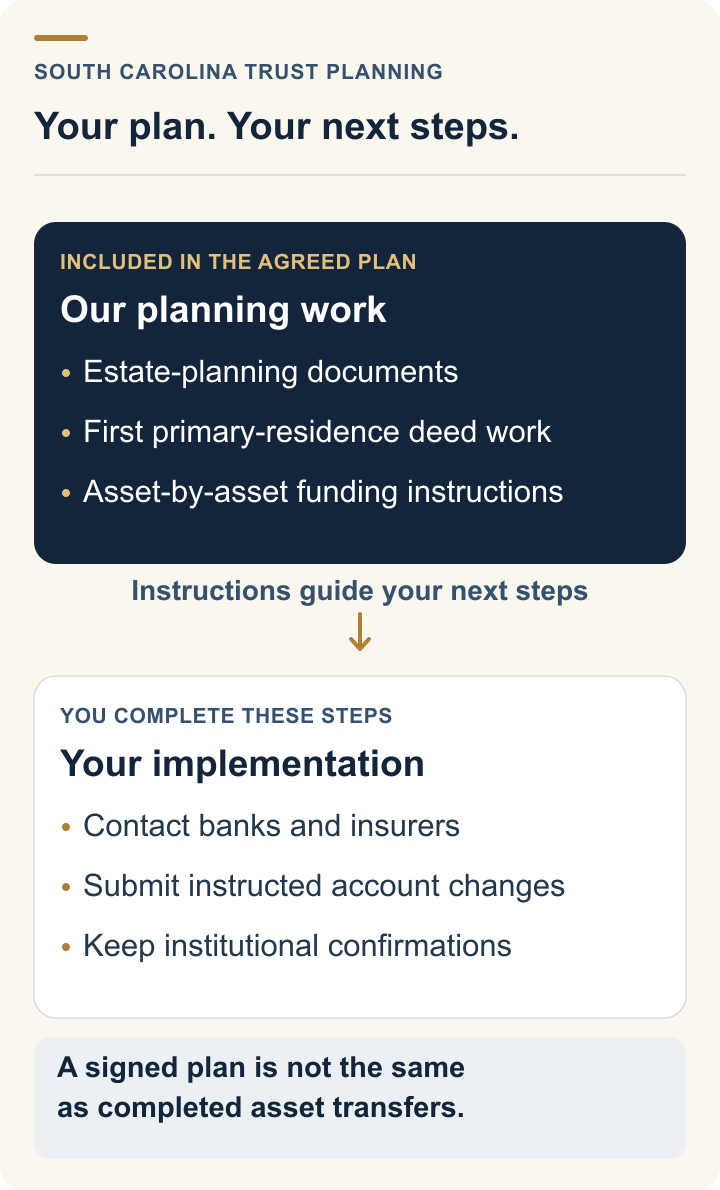
Trust-based plans include first-deed work for the primary residence and detailed instructions for funding the trust with each asset. That gives you a plan for what to do with relevant assets rather than a blanket instruction to “put everything in the trust.”
Your implementation responsibilities
You contact the relevant institutions, complete account retitling and beneficiary changes, and carry out the other transfers described in your instructions. We do not provide done-for-you institution letters, a funding-completion checklist service, completion verification, or ongoing funding review. Do not assume the firm is monitoring whether an institution has processed your forms.
| Asset or task | Included role | Your responsibility / scope question |
|---|---|---|
| Primary residence | First-deed work for the primary residence | Provide the requested ownership information; clarify the exact property and deed scope in the engagement. |
| Bank and investment accounts | Detailed asset-by-asset instructions | Contact the institutions and complete the directed account changes. |
| Life insurance | Instructions addressing the asset within the plan | Complete any instructed beneficiary changes and retain the insurer’s confirmation. |
| Retirement accounts | Asset-specific instructions, not a blanket retitling directive | Follow the instructions and complete appropriate beneficiary actions; do not treat these like ordinary checking accounts. |
| Additional property or business interests | Instructions within the agreed plan; no promise of additional transfer services | Identify separate legal, tax, title, or institutional work that needs its own scope or professional. |
Forgetting this division of work can leave a family with signed documents but unfinished implementation. Retain your own records of what you submitted and what each institution accepted. That is a practical suggestion for your records, not a promise that our firm verifies completion.
What the four-to-six-week process involves
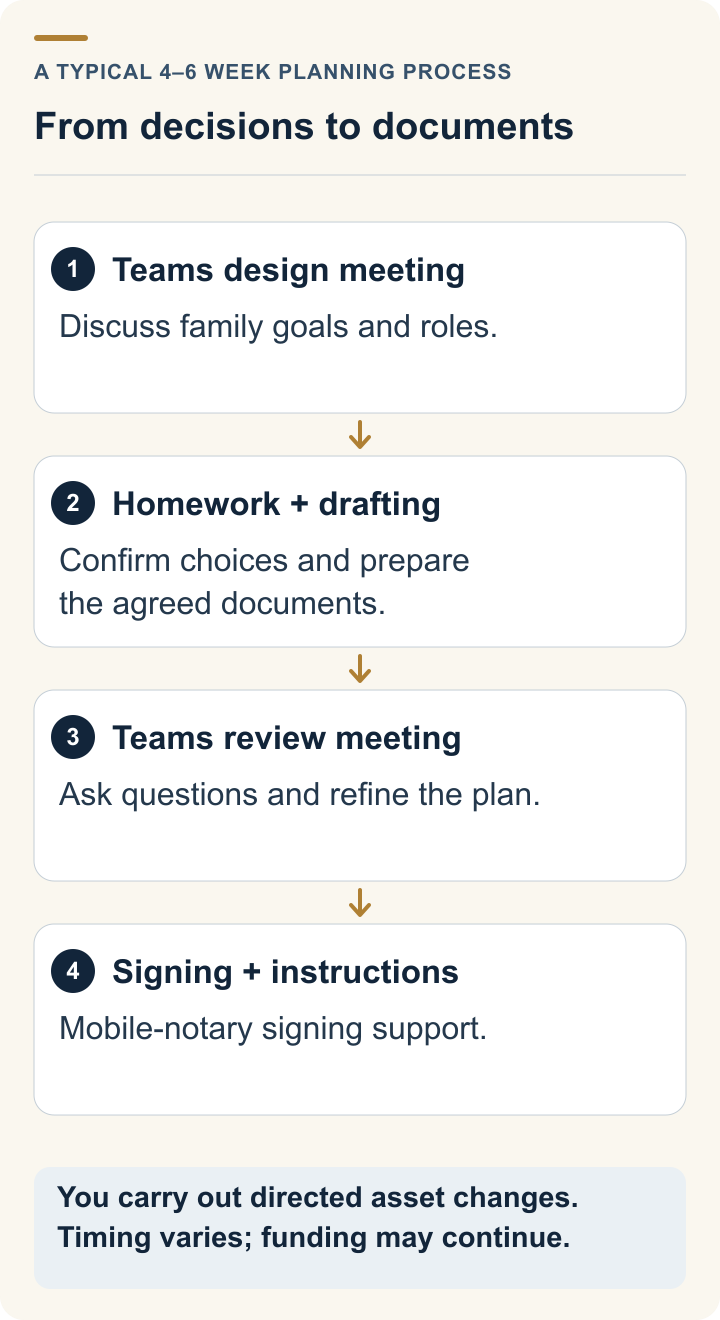
Our usual process takes four to six weeks, using two Microsoft Teams meetings, homework, and mobile-notary signing. That is a typical planning timeframe, not a guarantee that every asset transfer will be finished by the signing date.
Before and between meetings
Gather your existing documents, basic asset and ownership information, and the names of people you are considering for important roles. You do not need to send sensitive account numbers through a public contact form. Use the firm’s requested method for sharing confidential information.
The homework is substantive: thinking through the children’s needs, discussing guardian and trustee candidates, and checking facts. If you and your spouse have different preferences, write them down. It is easier to work through a concrete disagreement than an unspoken assumption.
Meetings, documents, and signing
The meetings and drafting process turn those decisions into the agreed documents. Ask questions when something does not match your understanding. Mobile-notary signing provides signing assistance; it does not mean every estate document is legally executed by notarization alone. For example, South Carolina’s ordinary will-execution rule generally requires the testator’s signature and two witnesses, subject to the exceptions identified in § 62-2-502.
Work schedules, unanswered questions, missing information, and document changes can affect timing. Tell us about a real deadline at the outset.
The decisions that matter most for children
For parents, the main value of the planning conversation is not learning a vocabulary list. It is making workable decisions for a difficult situation.
Raising children and managing money are different jobs
Discuss who you would want to care for the children and who you would want to manage money intended for them. The same person might be right for both roles, but the strongest caregiver is not automatically the best financial manager. Ask how the legal documents address each role; the trust is about its property and is not itself a court appointment of a child’s guardian.
“Not all at once” needs specific instructions
If your concern is a young adult receiving a large inheritance, discuss what money should be available for before outright distribution. Education, housing, health needs, and support can raise different judgment calls. A plan can be designed around staged distributions or continued management, but the actual terms—not the word “trust”—determine the arrangement.
Choose a workable backup
Talk about a successor if your first-choice trustee cannot serve. Consider organization, judgment, availability, and willingness to handle records and uncomfortable decisions. Trustees have legal duties: South Carolina requires administration in good faith, consistent with the trust’s terms, purposes, beneficiaries’ interests, and governing law. See § 62-7-801.
The useful question is not “Can this person be trusted?” alone. It is “Can this person do this particular job, potentially for years?”
Two hypothetical families, different planning needs
These examples are invented teaching scenarios, not client stories, quotes, or promises about results.
A couple, ages 38 and 39, with children ages four and two
They own a primary residence, have workplace retirement accounts, and each carry life insurance. Their main concern is who would handle money if both parents died while the children were young. One parent prefers a sibling as guardian; the other thinks a financially organized cousin would be a better trustee.
Their planning discussion should address those separate roles, backup choices, permitted support for the children, and the inheritance arrangement as the children mature. Their asset instructions should also distinguish the house, ordinary accounts, insurance, and retirement accounts. One beneficiary instruction should not be copied across every asset without considering what that asset requires.
The budget question is whether the quote covers the coordinated plan and explains implementation—not whether a provider can sell them a document containing the words “children’s trust.”
A remarried parent with a teenager and a younger child
This parent wants a spouse to remain secure while preserving an intended inheritance for both children. They already have older beneficiary designations and documents from before the marriage.
That requires a different conversation about the spouse’s needs, existing documents, asset ownership, and the terms controlling what happens after the first death. It is not safe to infer that the same trust language used for the first family would fit. Nor should the parent assume a revocable trust automatically defeats a spouse’s rights: § 62-7-401(c) specifically addresses elective-share issues involving revocable trusts.
Neither example establishes a price within our range. Each shows why describing the family accurately comes before comparing a final quote.
What a living trust does not guarantee
A trust can solve specific planning problems, but no plan can guarantee every outcome.
Not every asset automatically avoids probate. The result depends on ownership, beneficiary arrangements, and the particular asset. A trust document sitting beside an account statement does not necessarily change how that account passes. A pour-over will is a backup planning device, not proof that no probate proceeding will be needed.
A revocable trust is not a lifetime shield against your creditors. South Carolina expressly provides that revocable-trust property is subject to the settlor’s creditors during the settlor’s lifetime. The statute also addresses specified claims and expenses after death when the probate estate is inadequate. See § 62-7-505(a)(1) and (3).
A trust does not eliminate all future work. A successor trustee still has responsibilities, and a family may need legal, accounting, or other professional help. The plan’s potential value should be assessed against your goals—not a promise that future administration costs will be zero.
Ask for South Carolina-specific cost estimates; fees from another state may not apply.
Which costs can arise later?
Separate the cost of creating the plan now from the cost of changing or administering it later.
Ask what happens if you later amend the plan, buy another property, need additional deed work, or face a circumstance outside the original scope. Ask separately about recording charges or other third-party expenses relevant to your work. This article does not quote those amounts or promise they are included; confirm them in the written engagement before relying on a total budget.
A revocable trust can generally be amended or revoked under the applicable trust terms and statutory rules, but the method matters. South Carolina’s rule and qualifications appear in § 62-7-602. “Revocable” does not mean future legal drafting is automatically included in the original fee.
Later administration may involve trustee compensation. Under § 62-7-708, if the trust does not specify compensation, a trustee is entitled to compensation reasonable under the circumstances; the statute also addresses compensation stated in the trust. Do not assume choosing a relative makes administration cost-free.
Our planning engagement does not include ongoing funding review or a promise to revisit your accounts indefinitely. Reassess your own plan when circumstances change and ask about the scope of any additional work you request.
When a will-based plan deserves consideration
Do not buy a living trust because someone says every parent must have one. Start with your objectives, assets, desired management arrangements, and willingness to complete implementation.
A will-based plan can include a trust established through the will; South Carolina recognizes creation of a trust by will in § 62-7-401(a)(1)(i). “Will versus trust” is therefore not always the same question as “children receive everything immediately versus someone manages it.” The structure, timing, assets, and terms need discussion.
A revocable living-trust plan deserves consideration when you want coordinated management of trust property during life and after death, together with deliberate instructions for beneficiaries. A will-based approach deserves a fair comparison when it could meet your priorities without an unnecessary structure. Neither route should be chosen from a universal rule about having children or owning a house.
Our trust-planning overview explains the service and setup questions in more detail. Keep this article for comparing costs and scope; use that overview to explore how the structure works.
Seven questions to ask before hiring an attorney
Bring these questions to the conversation and request clear answers before engaging:
- What exact fee and scope apply to us? Identify the household members, documents, and work covered rather than relying on a headline range.
- Which decisions will we make together? Ask about children, guardians, trustees, backups, and inheritance terms.
- What does “funding included” mean here? Separate deed work, instructions, account forms, submission, and verification.
- What must we do ourselves? Establish who contacts institutions and carries out each asset change.
- What does signing involve? Clarify logistics and the requirements for the actual documents being signed.
- What is outside this engagement? Ask about additional property, later amendments, third-party expenses, and future administration.
- Can the usual schedule accommodate our needs? Share a deadline before assuming it can be met.
The aim is not a perfect questionnaire. It is a clear agreement about what you are purchasing, what decisions remain yours, and what work continues after signing.
South Carolina living trust cost FAQs
How much does a living trust cost in South Carolina?
Carolina Estate Plan’s trust-based plans range from $3,500 to $5,500. That is this firm’s range for a coordinated plan, not a statewide average or a quote for every family. Your engagement agreement should state the fee and scope applicable to you.
Does that fee include funding every asset for us?
No. Trust-based plans include first-deed work for the primary residence and detailed asset-by-asset funding instructions. You complete account retitling, beneficiary changes, and other transfers. The firm does not provide institution letters, a completion-checklist service, verification of completed funding, or ongoing funding review.
Can we complete the process virtually?
The planning process uses two Microsoft Teams meetings plus homework, with mobile-notary signing assistance. It usually takes four to six weeks. Virtual meetings do not remove the execution requirements for the particular documents, and the timeframe does not guarantee completion of all asset changes.
Does a living trust save more money than it costs?
No universal savings figure can answer that for your family. The result depends on assets, implementation, future events, and administration needs. A useful comparison weighs your management and inheritance goals alongside the upfront fee and possible later work; it does not assume probate, claims, or administration costs disappear.
Can a will protect children’s inheritances too?
A will-based plan can include a testamentary trust; South Carolina permits trusts created by will under § 62-7-401(a)(1)(i). Discuss how that structure would work for your assets and priorities compared with a living-trust plan. The appropriate choice is not determined by a blanket rule that all parents need the same documents.
Your next step: compare scope, not just price
For a busy parent, a good first step is simple: describe your family, what you own, and what you want money to do for the children if you cannot be there. You do not need to arrive with a finished trust design.
Review our South Carolina estate-planning services, then tell us about your family and request a free consultation. We will discuss your needs and the appropriate scope before recommending a plan.
General educational information, not legal advice for a particular family. Official South Carolina Code provisions were checked September 11, 2026.


