NC Inheritance Tax: What Families Need to Know in 2026
September 13, 2026 · Ryan P. Duffy


North Carolina has no inheritance tax and no separate state estate tax. Receiving an inheritance, however, is not the same as receiving an asset that will never generate a tax bill. Federal estate tax, distributions from inherited retirement accounts, and a later sale of inherited property are different questions.
For parents building a plan around their children, that distinction matters. A family may have no estate-tax exposure but still need a trustee to manage life insurance, a clear plan for an inherited IRA, and instructions that prevent a large outright inheritance at 18. Start with the asset and the family decision—not a tax strategy you may not need.
Does North Carolina have an inheritance tax?
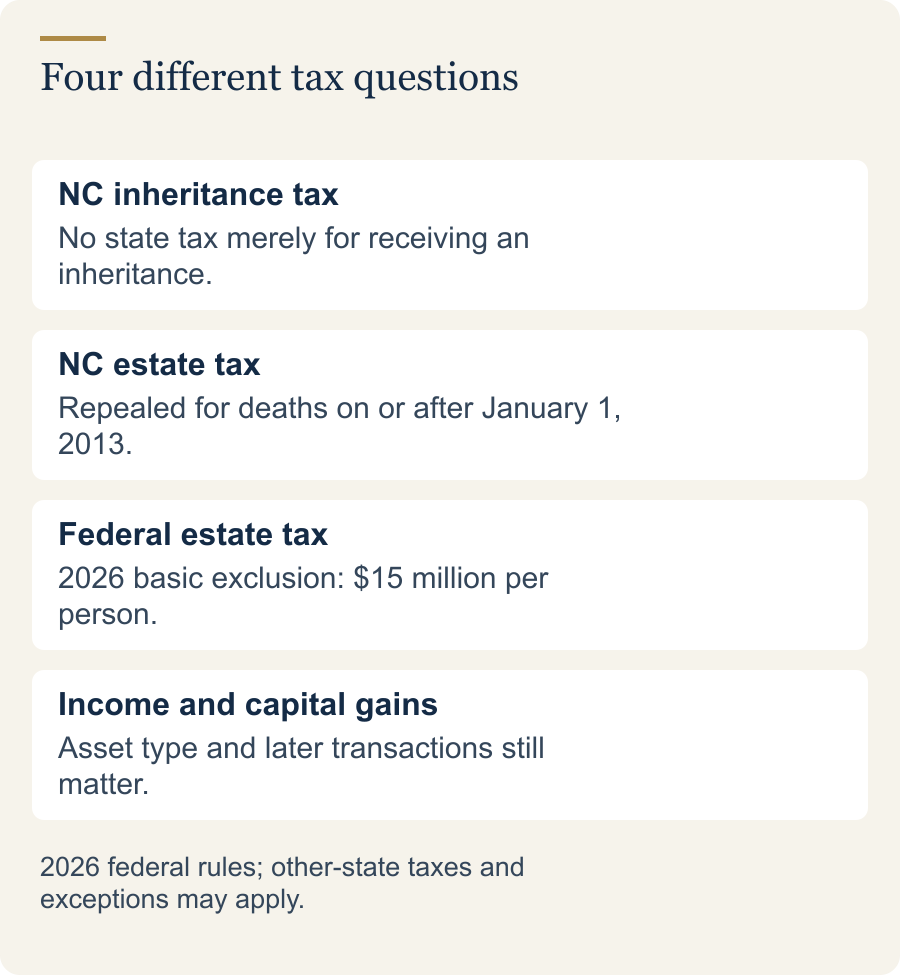
No. North Carolina does not impose a tax on a beneficiary merely for receiving an inheritance. The state also repealed its estate tax for people dying on or after January 1, 2013, under Session Law 2013-316, Section 7. Those are two distinct taxes: an inheritance tax is generally imposed on a recipient, while an estate tax is imposed on the transfer of an estate.
This does not settle every multistate situation. A deceased person’s residence and property in another state can create another state’s filing or tax obligations. Moving to North Carolina or having a North Carolina beneficiary does not, by itself, erase those connections. Income earned by an estate or by inherited assets is also a separate matter.
Read this diagram as text
NC inheritance tax: No state tax merely for receiving an inheritance. NC estate tax: Repealed for deaths on or after January 1, 2013. Federal estate tax: 2026 basic exclusion: $15 million per person. Income and capital gains: Asset type and later transactions still matter.
Federal estate and gift tax: the 2026 figures
The IRS’s current estate and gift tax guidance lists a $15 million basic exclusion per individual for 2026. The corresponding amount for 2025 was $13.99 million. The annual gift exclusion is $19,000 per recipient for both 2025 and 2026.
Older articles predicted that the larger exemption would expire at the end of 2025. Legislation signed July 4, 2025 changed that result; the old approximately $7 million “cliff” is not the current rule. Future legislation can change the law again, so use the rules for the relevant year of death or gift.
The $15 million figure is not simply a test of the cash in a checking account. Prior taxable gifts, property interests, and potentially life insurance or business interests affect the analysis. Deductions, credits, citizenship and residence can also matter. A married couple should not assume an unused exclusion automatically transfers to the survivor: an estate-tax return may be needed to elect portability. The Form 706 instructions explain filing requirements and elections.
Most ordinary family estates will not owe federal estate tax under these thresholds. For those that may, estate-tax planning should coordinate the attorney’s work with tax advice and valuations. A high exemption is a reason to identify the real problem, not a reason to abandon all planning.
Is an inheritance taxable income?
A cash inheritance generally is not income merely because you receive it. Interest earned afterward is different. An estate or trust can also distribute taxable income to a beneficiary and issue a tax form identifying that income. The label “inheritance” does not determine the treatment of every dollar.
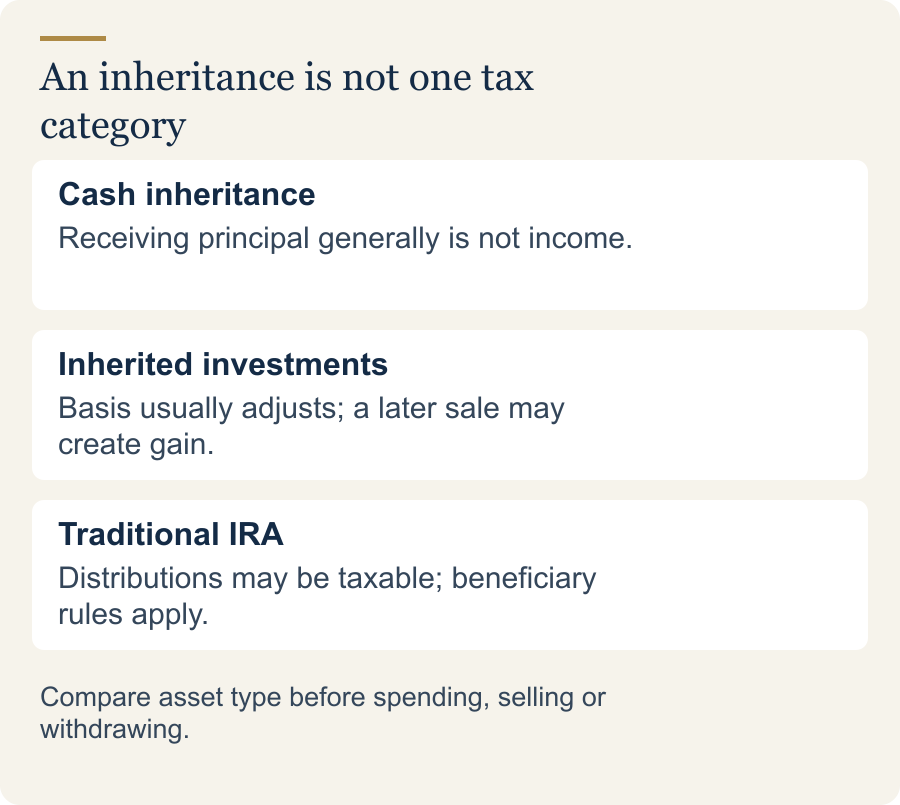
Consider a hypothetical parent receiving $250,000. If that amount is cash principal from an estate, the receipt generally is not taxable income. If it comes from a traditional inherited IRA, distributions can produce taxable income. If it represents proceeds from selling inherited stock, the property’s basis and sale price determine whether there is a capital gain or loss. These are not interchangeable transactions.
Read this diagram as text
Cash inheritance: Receiving principal generally is not income. Inherited investments: Basis usually adjusts; a later sale may create gain. Traditional IRA: Distributions may be taxable; beneficiary rules apply.
What happens when you sell inherited property?
Inherited real estate and investments commonly receive a basis adjustment to fair market value at death, subject to exceptions and special valuation rules. “Step-up” is common shorthand, but basis can also adjust downward. Certain income items, including many retirement benefits, do not receive that same treatment. See IRS Publication 551 on inherited-property basis.
Suppose inherited stock has a $250,000 adjusted basis and later sells for $270,000. Ignoring selling costs and other adjustments, the $20,000 difference—not the entire $270,000—illustrates the potential gain. A qualified appraisal and preserved date-of-death records can be more valuable than an estimate made years later.
Do not casually add a child to a deed just to “avoid taxes.” Lifetime gifts can carry different basis consequences from an inheritance, affect control of the property, and create other legal or benefits issues. Have the proposed transfer reviewed before signing or recording it.
Inherited IRAs need their own distribution plan
Many nonspouse designated beneficiaries are subject to a ten-year payout rule, but that is not the whole story. Eligible designated beneficiaries—including a surviving spouse, the account owner’s minor child, and certain disabled, chronically ill or near-age beneficiaries—can have different rules. Depending on the circumstances, annual distributions may be required before the end of year ten.
The IRS’s Publication 590-B explains beneficiary categories, required distributions, and trusts named as beneficiaries. Traditional-account distributions are generally taxable to the extent they are not a recovery of basis. Roth accounts have different tax rules, and a trust designation requires specific analysis. Before taking a lump sum, confirm the account type, the owner’s date of death, the beneficiary classification, and the applicable deadlines.

Gifts over $19,000 do not automatically mean tax is due
The annual exclusion generally applies to qualifying present-interest gifts. A gift exceeding it may require a federal gift-tax return and use part of the donor’s remaining lifetime exclusion without producing an immediate tax payment. Other reporting rules and exclusions can apply; direct payment of qualifying tuition or medical expenses has its own requirements.
Do not treat $19,000 as a universal permission slip. Gifts to trusts may not qualify automatically, and gift-tax rules are different from Medicaid transfer rules. Before giving appreciated property away, compare control, basis, tax reporting, and the recipient’s ability to manage it. Keeping an organized record of substantial lifetime gifts helps the eventual executor avoid reconstructing the history.
Plan for children even when estate tax is not a concern
For a couple with children aged four and two, the most useful questions may be: who will raise them if needed, who will manage their money, and when should they receive control? A will can recommend guardians, subject to court appointment. A revocable living trust can provide continuing management under chosen terms; it does not automatically reduce federal estate tax or shield the parents’ assets from creditors.
Our trust-based plans include agreed first-deed/primary-residence work and detailed asset-by-asset funding instructions. Clients handle institution forms, other transfers and beneficiary changes. Instructions are not confirmation that those steps have been completed.
Gather existing documents, account types and balances, property details, beneficiary designations, and candidate decision-makers. Then decide which legal tools serve the family rather than buying complexity solely because a headline mentions taxes.
Frequently asked questions
Do I file a North Carolina inheritance-tax return?
There is no North Carolina inheritance tax. Separate income-tax filings, federal estate-tax filings, or another state’s obligations may still arise from the actual assets and circumstances.
Does a living trust make an inheritance tax-free?
No. Probate treatment, estate-tax inclusion and income taxation are separate. A revocable trust generally leaves its creator’s assets within the federal estate-tax analysis.
Is life insurance part of the estate-tax calculation?
It can be, even when proceeds pass outside probate. Ownership and other rights matter. Do not equate a named beneficiary with automatic exclusion from the taxable estate.
Should I spend inherited retirement money immediately?
First confirm distribution and tax rules with the custodian and your tax adviser. A large withdrawal can concentrate taxable income in one year, and a missed required distribution can create a separate problem.
Make a plan that fits your family
For help coordinating guardians, trustees and inheritance timing in North Carolina or South Carolina, complete our consultation qualification form. This article provides general education, not individualized tax or legal advice.


Related estate planning guides
Use these next if you are comparing wills, trusts, probate avoidance, and the cost of a complete plan.
Have questions about your estate plan?
Ryan P. Duffy is a North Carolina and South Carolina licensed estate planning attorney. Schedule a free, no-pressure consultation to discuss your family's specific situation.
Schedule Your Free Consultation